Support This Website! Shop Here!

Monday, March 25, 2024

St. Paul's World

1Now concerning the things whereof you wrote to me: It is good for a man not to touch a woman. 2But for fear of fornication, let every man have his own wife: and let every woman have her own husband....  6But I speak this by indulgence, not by commandment. 7For I would that all men were even as myself. But every one hath his proper gift from God: one after this manner, and another that. (1 Cor 7:1-7)

After two millennia, St. Paul's world is finally coming into focus, where all men are like him, at least in regards to conceiving children. As anyone paying attention knows, the global total fertility rate (TFR) is dropping like a rock. According to a study of 204 countries published in the Lancet, 76% percent will fall below population replacement rates by 2050 (estimated global TFR 1.83), 97 percent will fall below by 2100 (estimated global TFR 1.59).  By 2100, only six countries will still have positive population growth.

I have pointed out elsewhere that the Catholic Faith was very successful in agrarian, subsistence-level societies, but does very badly (as do all faith systems) in technological, surplus-goods societies. While I could see that this was the case, I couldn't figure out why. However, while reading the following essay, this line jumped out. It resolved the issue:

This deep desire, by both men and women, to do meaningful and important work — not just have well-paid jobs — has a substantial negative impact on their desire to have children. 

The idea that every man and woman has meaningful and important work to do, this is an ancient and foundationally Catholic idea, bound up in Genesis itself:

The gods themselves exemplified the Greco-Roman attitude. In the entire pantheon, only one god was crippled and ugly - Hephaestus/Vulcan. He was the smith, the maker of technology, the only one who got filthy dirty in his craft. His feet were on backwards and he had been cast from the heights as a child because of his extreme ugliness....

... [But] out of all the pantheons of all the gods in all the cultures of the world, I am aware of only one culture which rejected the idea that manual labor was not fit work for divinity. That would be the Hebrew faith, the faith whose God actually worked with His own hands in the clay of the earth and breathed His own life into the clay His hands had formed....

...Labor was hard, but suffering in one's work was reasonable because... well, because we are meant to imitate Christ and HE suffered in His work. He was a carpenter, He worked in wood as He had long before worked with His Father in clay.

 Thus, John Paul II, in Laborem Exercens, can say:

Work is a good thing for man-a good thing for his humanity-because through work man not only transforms nature, adapting it to his own needs, but he also achieves fulfilment as a human being and indeed, in a sense, becomes “more a human being”.

This emphasis on the divine image that is manual labor is precisely why the Catholic Faith was particularly suited to agrarian societies. But, besides emphasizing the importance of manual labor, Catholic Faith did something else no one had ever done before. 

The Marriage of Intellect and Work

I have written elsewhere about the fact that intellectual superheroes are functionally non-existent in comic-book universes. Sure, some characters are described as being super-intelligent, but none of them actually display that super-intelligence. Felicity Smoak can crack codes and write programs in a time frame absolutely impossible for normal human beings, but when she is finally given physical deeds of derring-do to do, that is, when she finally becomes a classic superhero, she is immediately killed. 

Ancient agrarian societies have many variations on Hercules, but, apart from Odysseus and Loki, they have very few intellectual heroes. When intellectual heroes appear, they are tricksters and cheats, their good qualities matched or outweighed by the damage they do to those around them. Remember, while Odysseus is the hero of the story, he is able to save only himself. He gets all of his companions killed.

Agrarian, subsistence-level societies value strength over intellect because agrarian societies don't expect anything to change. Great intellect is not needed. The great-grandson's life is not expected to be any different from that of his great-grandfather. Children live the professions of their parents, grandparents, great-grandparents. Intellectual pursuits are the hobby of the rich, a way of virtue-signaling one's superiority to those who worked with their hands. Most of the ancient philosophers came from wealthy families.   

The Catholic Faith changed this equation. Intellectual pursuits were originally just a form of wealthy virtue-signaling. With Catholicism, instead of merely virtue-signaling, the intellectual was expected to do meaningful work that directly benefited others. Catholic intellectuals did not just answer theological questions, such as the true nature(s) of the God-man, or the intricacies of how the sacraments worked. Intellectuals could also answer questions about the natural world, the world God had made with His own hands.

As a result, Catholic society was no longer bifurcated into a slave world and an intellectual world, as it had been in the pagan Greco-Roman age. Rather, the two worlds were joined together in a common task: building up the city of God. The intellectuals were now tasked with improving the lot of the wage-slave. That meant the intellectuals were duty-bound to lighten the burden of the slave, make his work easier, encourage the use of tools, investigate the physical world to assist in the work of creating a richer life for all. Monastics built labor-saving machinery so they could spend more time at the altar. This labor-saving machinery also allowed the common laborer to do the same.  

Contrast this attitude with the ancients. The ancient Greeks and Romans knew about steam power and automation, but Greco-Roman intellectuals never thought to apply these advances to assist common people. Precisely because the God of the Hebrews and the Catholics was the god of slaves, a God who worked with His own hands in the clay, the Catholic Faith was originally the faith of slaves and women: 

For as many of you as have been baptized in Christ, have put on Christ. There is neither Jew nor Greek: there is neither bond nor free: there is neither male nor female. For you are all one in Christ Jesus" (Galatians 3:27-28)

The unrecognized intellectuals within these groups finally had an outlet for their intellectual activity, a way to meld the work of the hands with the work of the mind. The celibate life became a way for a man or woman to devote him/herself to intellectual pursuits. Even the slave or the woman could do it. The slave priest or the Christian consecrated virgin could receive enough money to live on from fellow Christians while devoting themselves not just to the spiritual needs, but also the physical needs, of their fellow slaves.

This had never before been possible. In both Judaism and pagan societies, having children and family was a divine ordinance: For instance, in both Hinduism and Judaism, the priesthoods are hereditary. Pagan Rome had Vestal Virgins, but there were only ever six of them at a time. Even then, they took their vows between the ages of six and ten, and they were sworn to celibacy for thirty years. Widespread celibacy was seen as an attack on society, the loss of fertility that was created by celibacy was penalized by the community. 

The First Great Divorce

Catholic celibacy, on the other hand, was celebrated. It was not restricted to a tiny priestly elite, rather, it was recommended for everyone who could handle it. Catholics deliberately and systematically destroyed family life as the highest goal, and replaced it. Celibacy became the highest goal. This was a radically new idea. However, as the historical dominance of celibate men and women in technological progress shows, the deliberate destruction of the family  turned out to be beneficial not just for spiritual pursuits, but also for technological progress.

Celibacy, the release from family obligations, allowed the great majority of scientific advances made in the Middle Ages and the Renaissance. Right up through the Enlightenment, deacons, priests and bishops made up the majority of what we now call scientists. The celibacy that allowed intellectuals to focus entirely and exclusively on intellectual pursuits led to the massive success of those same intellectual pursuits. Because Catholic celibacy was now the highest goal in life, and because celibacy could be pursued by anyone, everyone with the capacity to be an intellectual could now become one. It is estimated that between 15 and 25% of the Medieval European population was celibate. This was possibly the largest creation of a dedicated intellectual workforce in history.  

The Second Great Divorce

Clearly. Catholic celibacy promoted scientific progress. So, why did the science and faith divorce? They divorced because people began to realize that 

This deep desire, by both men and women, to do meaningful and important work — not just have well-paid jobs...

did not actually require the religious aspect in order to succeed. Procreative control could be accomplished using other rationales. Thus, we should not be surprised to see the "conflict thesis", the idea that religion is opposed to science, arose precisely over the problem of procreation. 

Darwinian biology directly implied "eugenics". Eugenics was a radically new attack on family life. Darwin's work implied that, not only was celibacy, or at least the refusal to procreate, a positive good, celibacy was so good that it should be imposed on people who were not biologically qualified to procreate. Religion permitted celibacy for those capable of intellectual pursuits. Science now wanted to impose celibacy on those who were not capable of intellectual pursuits. Both Catholicism and science saw themselves and their worldview as improving society, but the question of which should have the power over procreation now became the centerpiece. Because Catholicism refused to coerce celibacy, it was branded anti-scientific. Eugenics fought, and still fights, Christianity on this point. 

Now, it is one of the great ironies of evolutionary theory that, apart from Darwin himself, the people who proposed survival of the fittest, and who stress the importance of eugenics don't themselves have replacement level fertility. That is, ardent evolutionists apparently don't see themselves as worthy of procreating. But, leaving this aside, we can now see why surplus-goods societies don't have replacement-level fertility. 

This deep desire, by both men and women, to do meaningful and important work — not just have well-paid jobs — has a substantial negative impact on their desire to have children.... 

... Work is a good thing for man-a good thing for his humanity-because through work man not only transforms nature, adapting it to his own needs, but he also achieves fulfilment as a human being and indeed, in a sense, becomes “more a human being”.

Child-Free: More Human?

Everyone wants to "become more a human being." People began to see it was not the religion, but the worldview that allowed people to pursue child-free lives, that made radical help for the poorest of the poor, possible:

31 And they that use this world, as if they used it not: for the fashion of this world passeth away. 32 But I would have you to be without solicitude. He that is without a wife, is solicitous for the things that belong to the Lord, how he may please God.  33 But he that is with a wife, is solicitous for the things of the world, how he may please his wife: and he is divided. 34 And the unmarried woman and the virgin thinketh on the things of the Lord, that she may be holy both in body and in spirit. But she that is married thinketh on the things of the world, how she may please her husband

Childhood and poverty are closely linked. The corporal works of mercy are identical whether a parent applies them to his child or a celibate applies them to the poor. Both the Catholic and the technologist want "the fashion of this world to pass away." Both want a better life for the children, the only difference being that the technologist, the social justice warrior, sees the government as the Church and the poor as the children. Both realize that avoiding procreation helps bring those who avoid it into razor-sharp focus on what matters. The focus of the child-free person allows that person to build a better life for everyone. 

The Logical Conclusion

So, if we are to free the world of poverty, and if the poor man is but a kind of child, then the technology which rids the world of poverty establishes the greatest good. The child-free society that Paul originally recommended to everyone moves everyone towards that good. Like the child-free monks of old, technologists strive to be free of the concerns of this world. The focus on technological advance and labor-saving machinery can remove our concerns about food, clean water, medical care, housing, poverty in general. We can achieve a technologically poverty-free society by pursuing a child-free life. 

People who have children are not as good as people who don't. Catholic faith has long taught this as a foundational truth. Can anyone blame the world for taking the lesson to heart?.

As the original essayist proposed, it may soon be the case that work and progress will be made so easy, that child-bearing and child-rearing may again be permitted to become an important work to society. After all, as the essayist notes, the rich are now having more children than they have traditionally had in the last few centuries. However, it is also possible that most modern cultures will follow the example of Rome, and simply collapse from dropping fertility rates.

But, for good or ill, the dropping fertility rate of our surplus-goods societies are merely the  world answering the radical call St. Paul made two millennia ago. At the moment, all are becoming like him, and forgoing procreation.


Wednesday, March 20, 2024

Marriage, in Fine

 Gender is an attribute of grammar, not sexuality.

Your sex is established at conception, and cannot be changed.
The word "marriage" appeared around 1300 and likely descended from the Old French "mariage" of the 12th Century and the Vulgar Latin "maritaticum" of the 11th Century, ultimately tracing to the Latin "maritatus", past participle of "maritare". Thus, the word "marriage" ultimately derives from Latin mātrimōnium, which combines the two concepts: mater meaning "mother" and the suffix -monium signifying "action, state, or condition."
Marriage referred to a right to inheritance. A man in the Roman Empire might have many concubines, sex slaves, prostitutes, etc., and might conceive children with all of them. However, only the offspring of the woman he married would have a right to inherit his estate. 

In short, to "marry" someone refers to the man's ability to make a woman into a mother, who bore children who could inherit. Thus, someone conceived and born as a woman cannot "marry" another woman, nor can someone conceived and born as a man "marry" another man.

Sunday, March 17, 2024

Prenups and Catholics

 Why Women Should Want a Prenup

The linked TikTok above makes a hell of a good point.

Now, according to Catholic doctrine, it is a sin, and renders a marriage invalid, for you and your prospective spouse to write a prenup. It is worse if, as in this example, one of the two spouses might attempt to write their own, without telling their partner.

But it's not like you don't end up with a prenup. You always have a prenup. If you don't write it, then the government writes it. .

Now, you can argue that since you and your fiancee didn't write it, it isn't your fault that this situation exists. OK. But you cannot know you are even entering into a marriage. Even if you have correct intent, etc., your intended may not.

You know you're receiving absolution, you know you're receiving the Eucharist, you know you are being confirmed, baptized, anointing of the sick, ordained.

But you never really know if you're getting married, nor do you know, once through the ceremony, if you are, in fact, married. 

Bible Lengths

Jewish version

The Hebrew Bible is generally considered to consist of 24 books, but this number is somewhat arbitrary, as (for example) it regards 12 separate books of minor prophets as a single book. The traditional rabbinic count of 24 books appears in the Talmud and numerous works of midrash

https://en.wikipedia.org/wiki/Hebrew_Bible

But even here, it depends on whether you accept the corrupted and relatively less complete Masoretic text (written in Assyrian Hebrew) or the Septuagint (written in Greek). Keep in mind, the Masoretic isn't written in the same Hebrew that Moses used. The original Old Testament scriptures were written in Paleo-Hebrew, a text closely related to the ancient Phoenician writing system. The Masoretic Text, on the other hand, is written with an alphabet which was borrowed from Assyria (Persia) around the 6th-7th century B.C., and is almost 1000 years newer than the form of writing used by Moses, David, and most of the Old Testament authors. 

https://russian-faith.com/explaining-orthodoxy/russian-bibles-are-totally-different-american-ones-heres-why-n1470

Luther's version

Luther built his Old Testament on the corrupted, incomplete Masoretic text. Luther also considered the New Testament books of Hebrews, James, Jude, and the Revelation to be "disputed books", which he included in his translation but placed separately at the end in his New Testament published in 1522. His translation also places what Catholics view as the deuterocanonical books in an intertestamental section, between the Old Testament and New Testament; he called these books Apocrypha. The books of the Apocrypha, in the Lutheran tradition, both Old and New Testament, are non-canonical, but "worthy of reverence."  

Following Luther's lead, in 1596 Jacob Lucius published a Bible at Hamburg which labeled as Apocrypha Luther's four Antilegomena: Hebrews, James, Jude and Revelation; Lucius explained this category of "Apocrypha" as "That is, books that are not held equal to the other holy Scripture". David Wolder, the pastor of Hamburg's Church of St. Peter, published in the same year a triglot Bible which labeled those books as "non canonical". J. Vogt published a Bible at Goslar in 1614 similar to Lucius'. In Sweden, Gustavus Adolphus published in 1618 the Gustavus Adolphus Bible with those four books labeled as "Apocr(yphal) New Testament." The Luther Bible is widely used by Anabaptist Christians, such as the Amish.

https://en.wikipedia.org/wiki/Luther%27s_canon

Other Protestant versions

The non-Lutheran Protestant versions settled on 66 books, keeping Luther's Old Testament, but rejecting his shortened version of the New Testament.

Catholic version

Catholic Bible has 73 books (if Lamentations is separate from Jeremiah). It is based on the Septuagint for the Old Testament. 

https://en.wikipedia.org/wiki/Catholic_Bible

Coptic version

The Coptic Bible has 74 books, it includes the Prayer of Manasseh.

https://copticchurch.online/en/bible-books/

Slavic Orthodox version

The Slavic Bible has in excess of 70 books, but is based on the corrupted Masoretic text.

https://russian-faith.com/explaining-orthodoxy/russian-bibles-are-totally-different-american-ones-heres-why-n1470

Greek Orthodox version

The Greek Orthodox Bible—without an official number—is somewhat larger, with somewhere between 75 and 79 books.

https://earlychristiantexts.com/how-many-books-in-the-bible/

Ethiopian Christian version

The Ethiopian Bible, which is perhaps the oldest Christian Bible, includes somewhere between 81 to 84 books, depending on different factors.

https://earlychristiantexts.com/how-many-books-in-the-bible/

https://en.wikipedia.org/wiki/Orthodox_Tewahedo_biblical_canon

http://www.ethiopianorthodox.org/english/canonical/books.html


Wednesday, March 13, 2024

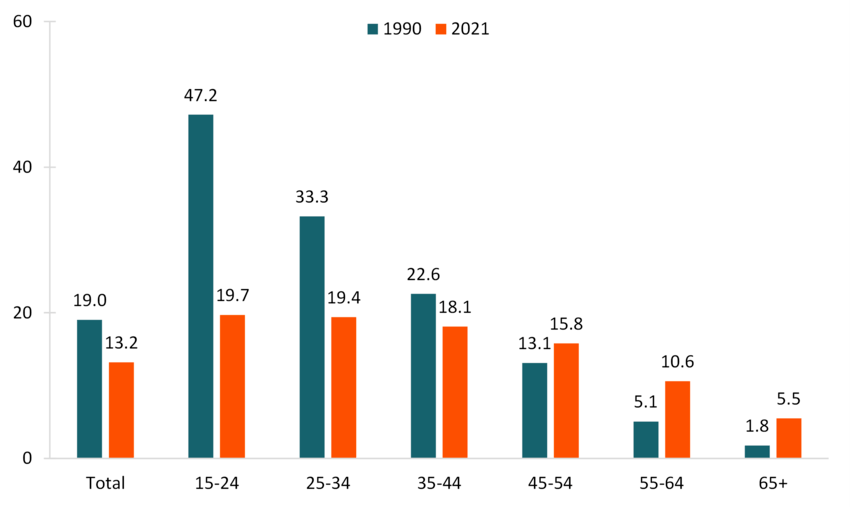
Internet Makes Teens Mature Faster

Interesting stats here. According to this article, the divorce rate among teen couples has dropped to match that of adults. It's almost as if the Internet and smart phones makes teens mature faster.

2021 divorce rate for 15-25 was 19.7
2021 divorce rate for 25-34 was 19.4 
2021 divorce rate for 35-44 was 18.1

Women are now LESS LIKELY to get divorced between 15 and 24 then they are between 25 and 44.


The divorce rate for teenagers is now indistinguishable from that between 30-year olds. Either teenagers are maturing faster, are adults are becoming less mature.

Given that divorce rates dropped, it seems that smart phones and the Internet might be making teens MATURE FASTER. 

That is counter-intuitive.

Saturday, February 03, 2024

John Vianney, the Cure d'Ars

 "In 1809, though still a student, John Vianney was recruited in the draft. However, because he failed to join his detachment in Renaison, John was considered a deserter. Finding refuge in a small village known as Les Robins, John Vianney settled there for a couple of years. Although this village was obscured by the forest, the gendarmes still arrived to meticulously search for deserters. John Vianney, who had only seconds to hide, dove into the hayloft, where he felt himself sweating and could hardly breathe..."

... Since he had deserted, he had to be replaced in the Napoleonic armies. His brother François was drafted into the army in his place, went to the front to Phalsbourg (Moselle today the borders of Alsace) and died in the fighting. "

Sunday, January 07, 2024

Salvation Forbidden to Latin Rite

So, now a senior Vatican official is making the case for a married priesthood:

Priests are allowed to marry in the Eastern Rite of the Catholic Church as well as in the Orthodox, Protestant and Anglican Churches.

Opponents of a married priesthood say celibacy allows a priest to dedicate himself entirely to the Church.

In 2021, the pope dismissed a proposal to allow some elderly married men to be ordained in remote areas in the Amazon where in some places the faithful saw a priest as little as once a year.

You know, if it was REALLY the case that the sacraments are the centerpiece of Christian life, that the sacraments are essential for salvation, or anything like that, then this would be a no-brainer. Of course, you would allow the salvational needs of lay people to trump a mere discipline of the Church, a discipline that has been permitted in the past, and is currently established otherwise within various other liturgical-sister organizations. In fact, the discipline of married priests is even permitted within the Catholic Church in 20 of the 21 rites of the Church.

So, if you cared about the salvation of people in the Amazon, or lay people anywhere, for that matter, the discipline would have to be relaxed in order to help assure the salvation of the laity who rely on the priesthood as the sole officially recognized conduit of saving grace, i.e., sacramental grace. Without this discipline relaxation, the lay faithful are cut off from the sacrament of the Eucharist, the "source and summit" of Catholic faith.

But, that's not how Pope Francis or previous popes see it. The laity can literally go to hell, and the Church still won't relax a mere DISCIPLINE. Keep in mind, the Church is happy to bless homosexual persons who are engaged in an intrinsically evil relationship, but she won't grant the actual saving grace of liturgical sacraments to Latin-rite laity if those sacraments need to come to said laity through a married priesthood. Other rites can be saved by the sacramental action of married priests, but Latin-rite laity can literally go to hell unshriven due to lack of priests to absolve in confession or confect Anointing of the Sick. 

It is increasingly hard to see how any of this makes sense. 

Now, I will readily grant that once celibacy is no longer required in the Latin Rite, then celibacy will be gone FOREVER. It will never come back. 

Vocations come from large families. Large families come from poor families with high infant mortality rates. The TFR for all first-world countries is below 2.1 children per woman. The TFR for sub-Saharan Africa is still well above that, but over the course of the next century, those countries will leave poverty behind. As poverty drops, education increases and more children survive into their teen and adult years. As they do, the TFR of sub-Saharan countries will drop to that of first-world countries. As family sizes drop, ordinations will drop. Every country in the world will soon occupy the same space the remote Amazonian tribes live - far from priests, far from sacraments, far from the Mass, no way to remedy any of it. 

Without high TFR there simply won't be any ordinations to speak of, and that spells the end of the Church or at least the end of the celibate priesthood. Allowing married priests is a sea change that cannot be undone or walked back. Given that a married priesthood won't have any effect on TFR, it will only incrementally extend the life of the Church.

But, which does the Church value more? 

The discipline or the sacraments? 

Tuesday, December 19, 2023

Fiducia Supplicans

 "Fiducia supplicans, issued by the Dicastery for the Doctrine of the Faith and approved by Pope Francis, has reaffirmed that the Church does not have the power to impart a liturgical blessing on irregular or same-sex couples or to bless their union," McManus said. "It can, however, offer a type of blessing that can be conferred on anyone to invoke God’s help and mercy in their lives if the individuals seek to be guided by a greater understanding of God’s plan for love and truth. These blessings are offered for the people themselves, not their union."
Of course, the problem for the good bishop, for the Pope, and for the Church as a whole, is precisely what Fiducia Supplicans says:
25. ... Thus, when people ask for a blessing, an exhaustive moral analysis should not be placed as a precondition for conferring it. For, those seeking a blessing should not be required to have prior moral perfection.
Well, who can seek these blessings? Well, the preface to the document explains: 
It is precisely in this context that one can understand the possibility of blessing couples in irregular situations and same-sex couples without officially validating their status or changing in any way the Church’s perennial teaching on marriage.
Notice blessings are not restricted to individuals. The document explicitly specifices that blessings may be bestowed upon "same-sex couples." Now, homosexual inclination is intrinsically disordered, while homosexual activity itself is intrinsically evil. What stops a priest from blessing polygamy? Sure, the document may specify "couples", but certainly any two-person combination of a polygamous relationship would constitute a couple. 

If we are now able to bless intrinsically evil situations, then can we ask for a blessing on our abortifacient pills? Can a woman and her abortionist ask for a blessing before they enter the abattoir to slaughter a child? In principle, there is no clear reason why such blessings couldn't be delivered, as we are not supposed to bother our sweet little heads with "an exhaustive moral analysis."

And, to be fair, this nonsense did not start with Pope Francis. Read this passage from FS...
40. ... Indeed, through these blessings that are given not through the ritual forms proper to the liturgy but as an expression of the Church’s maternal heart—similar to those that emanate from the core of popular piety—there is no intention to legitimize anything, but rather to open one’s life to God, to ask for his help to live better, and also to invoke the Holy Spirit so that the values of the Gospel may be lived with greater faithfulness.
Then read what Pope Benedict had to say about the use of condoms by heterosexual couples: 
"There may be justified individual cases, for example when a male prostitute uses a condom, where this can be ... a first bit of responsibility, to re-develop the understanding that not everything is permitted and that one may not do everything one wishes," Benedict was quoted as saying.
"I personally asked the pope if there was a serious, important problem in the choice of the masculine over the feminine," [Vatican spokesman] Lombardi said. "He told me no. The problem is this ... It's the first step of taking responsibility, of taking into consideration the risk of the life of another with whom you have a relationship." [There is that insistence that condom use is a move towards objective good. Again.]

"This is if you're a woman, a man, or a transsexual. We're at the same point. The point is it's a first step of taking responsibility, of avoiding passing a grave risk onto another," Lombardi said.

Do you see the similarity between the concepts here? Fiducia Supplicans merely re-iterates in 2023 what Pope Benedict privately told a reporter for an Ignatius Press book in 2010. And, to be fair, Pope Benedict's statement was merely a positive affirmation of the negative nonsense that emerged from JP II's TOB. In a series of audiences that were ostensibly about the human body and human sexuality, JP II managed to omit all discussion of children, family and suffering.

How on earth do you develop a theology of human sexuality without even mentioning children or family? What kind of theological nonsense pretends to be a theology of the body, yet does not mention suffering? The Second Person of the Trinity took on human flesh, a human body, in order to suffer and die, yet you don't mention suffering or death in your Theology of the Body? SERIOUSLY? 

John Paul II's TOB audiences were so atrocious that, once delivered, they are never again referenced by any Magisterial document. There is a straight line from JP II's silence, through Benedict's "moral" condom use to Francis' blessing of same-sex couples. The papacy has been building this line for the last fifty years.

So, don't be surprised to see a new liturgical rite within the next 18 to 24 months for the ordination of women deacons. It may differ from the male rite of ordination, but it is coming. Pope Francis made that clear when he started washing women's feet on Holy Thursday in 2013. 

As I've noted elsewhere, the Catholic Faith was a superb faith for a subsistence-level society. But Catholic ideas are completely unable to adequately respond to a surplus-goods society. One of the hallmarks of the wealth the world is now experiencing is a change in the foundational meaning of human sexuality. In a subsistence-level society, procreation is the foundational meaning, but in a surplus-goods society, human sexuality becomes primarily about communication, not procreation. If the Church has no poor to minister to, She has no way to evangelize. If the foundational meaning of sexuality changes, her message cannot be changed to match without breaking everything that came before. 


UPDATE:

Homosexual activity may be intrinsically evil, but the participants can be blessed, as long as they aren't participants in a duel. If you are, you don't even get the sacrament of confession. In fact, if a priest tries to absolve a penitent involved in a duel, the priest will be excommunicate.

[From the Response of the Holy Office to the Bishop of Poitiers, May 31, 1884]

To the question:

1862 I. Can a physician when invited by duelists assist at a duel with the intention of bringing an end to the fight more quickly, or simply to bind and cure wounds, without incurring the excommunication reserved simply to the Highest Pontiff? 

 II. Can he at least, without being present at the duel, stay at a neighboring house or in a place nearby, ready to offer his service, if the duelists have need of it.

III. What about a confessor under the same conditions?

The answers are: 

To I, he cannot, and excommunication is incurred.

To II and III, that, insofar as it takes place as described, he cannot, and likewise excommunication is incurred.

Tuesday, November 07, 2023

Who is a Christian? Who is a Jew?

Who is a Christian?

Determining who is a Christian is a somewhat daunting task. Liturgical Christians, such as the Catholics, Eastern Orthodox and Copts, would say a Christian is a baptized person, or at least someone actively seeking baptism. Non-liturgical Christians, like Baptists or Anabaptists, would say becoming a Christian is merely a matter of accepting Jesus Christ as your personal Lord and Saviour. Anyone who proclaims with their mouth that Jesus is Lord, and believes in their heart that He is risen from the dead, is a Christian. 

Since the act of baptism is understood to deliver the grace to believe in Christ, a Christian is defined by by belief, and to a certain extent, or for certain groups, by baptism. "Right belief" (aka orthodoxy) is paramount, and the extent of right belief is not limited to the deity of Christ. It also includes proper understanding of the Trinity. So, even though Mormons agree that Jesus Christ is God, Mormons are not considered Christians because Mormons insist that the Trinity is made up of three SEPARATE persons, while Christianity teaches the Trinity is made up of three DISTINCT persons. 

The difference between "separate" and "distinct" is important. Each member of a family is separate from every other member. Even conjoined (aka Siamese) twins each have separate body parts that only one of the two twins control. Distinct, on the other hand, is like the facets of a diamond: each facet is distinct, but all the facets together are aspects of the same diamond.

In a similar (but not identical) way, the One Divine Nature is completely owned by each of the Three Persons, each Person of the Godhead owning the one Divine Nature completely unto Himself, the Godhead is not shared. Yet there is only one Godhead. It is not clear how this works, Christians are just required to believe that it does. In this sense, understanding the Trinity is similar in some aspects to understanding quantum mechanics or gravity - we don't know how it works, we just know that it does.

Who is a Jew?

If defining a Christian is hard, now let's try defining who is a Jew. Being Jewish is neither a matter of belief nor a matter of praxis. Christians have a hard time wrapping their heads around this:

It is important to note that being a Jew has nothing to do with what you believe or what you do. A person born to non-Jewish parents who has not undergone the formal process of conversion but who believes everything that Orthodox Jews believe and observes every law and custom of Judaism is still a non-Jew, even in the eyes of the most liberal movements of Judaism, and a person born to a Jewish mother who is an atheist and never practices the Jewish religion is still a Jew, even in the eyes of the ultra-Orthodox. In this sense, Judaism is more like a nationality than like other religions, and being Jewish is like a citizenship.

Unfortunately, being Jewish is not identifiably genetic either: 

Genetic markers cannot determine Jewish descent: 

It becomes overwhelmingly clear that although Jews maintained detectable vertical genetic continuity along generations of socio-religious-cultural relationship, also intensive horizontal genetic relations were maintained both between Jewish communities and with the gentile surrounding. Thus, in spite of considerable consanguinity, there is no Jewish genotype to identify. 

And since it is not genetically identifiable, being Jewish is most assuredly not a tribal or national identity: 

The refusal of the [Israeli] Supreme Court to accept the plea of 21 citizens [most of them well-known veterans of movements of civil rights], to recognize them as belonging to an Israeli nation […] is another expression of the failure of the civil struggle for the image of Israel. Sixty-five years after its establishment the authorities do not recognize an Israeli nation, disconnected of a religious definition or ethnic belonging. […] 

In their decision, the judges deny the existence of an Israeli nation, and assert that it has not been proven that an Israeli nationality disconnected of a religious definition or ethnic belonging exists...  

...Judge Haim Cohen responded: “the definition must be given by every single Jew for himself. If a person says of himself that he is a Jew, for me he is a Jew. This is his autonomy and nobody can decide for him or instead of him whether he is a Jew or not. There is no need in definitions.”  

Now, it is clearly the case that many (but not all) Jews have distinct DNA links to historical groups. The Cohen priesthood lineage, for example, is interesting:

The results of the analysis of the Y chromosome markers of the Cohanim and non-Cohanim were indeed significant. A particular marker, (YAP-) was detected in 98.5 percent of the Cohanim, and in a significantly lower percentage of non-Cohanim (emphasis added).

FURTHER CONFIRMATION

In a second study, Dr. Skorecki and associates gathered more DNA samples and expanded their selection of Y chromosome markers. Solidifying their hypothesis of the Cohens' common ancestor, they found that a particular array of six chromosomal markers was found in 97 of the 106 Cohens tested.

But, notice, the DNA linkage is not perfect. There are a significant number of gentile men who bear the Cohen gene, yet are not identified by anyone as being Jewish. There are Jewish men who claim to be descended from the ancient priestly caste, they are even recognized as being related to that caste, yet  they have no DNA marker to indicate that they actually are. Genetic tests may show that two-fifths of Ashkenazi Jews are descended from four women, but that means three-fifths are not. And it says nothing at all about Mizhraic, Sephardic, Ethiopian, or Cochin Jews, the last two of which trace their own lines via patrilineal descent, not matrilineal descent. 

Insofar as anyone can genetically link back to ancient populations, the group with the BEST claim to that connection are the Lebanese, who are over 90% genetically identical to the ancient Canaanites, the original indigenous population.

Despite this, Israel still uses genetic testing to determine if someone is Jewish.

In February of this year, the Israeli newspaper Haaretz, reported that the Chief Rabbinate of Israel, the peak religious authority in the country, had been requesting DNA tests to confirm Jewishness before issuing some marriage licenses.

But, this farcical "genetic Judaism" is no more or less reliable than the claim to be genetically a Viking: 

Vikings as a group don't exist anymore.

However, they have descendants all over Europe and the Scandinavian countries.

In many Scandinavian countries, many people dedicate their lives to living like the Vikings did long ago. 

There are Viking villages in Norway and Sweden where people recreate the Viking way of life.

So, we have the odd situation wherein there seems to be no clear definition of what constitutes being Jewish, nor any authority who can clarify it. There are merely a lot of people who recreate what they understand to be the ancient Jewish way of life, and on that basis, claim to be Jewish.

But there is not even any real agreement on what constitutes that way of life. For instance, Jews who accept the Talmud as authoritative will necessarily follow the teachings of one or more of the rabbis whose commentary makes up the Talmud. Such Jews will insist that anyone born of a Jewish mother is Jewish, regardless of belief, because that's what they read in the Talmud. Of course, this opens the question: which Talmud? For there are actually two versions, and no clear way to determine which is authoritative: the Babylonian Talmud or the Jerusalem (Palestinian) Talmud? 

The differences are significant. For instance, the Jerusalem Talmud says, "“Whoever saves a single life is considered by scripture to have saved the whole world." while the Babylonian Talmud says, ""Whoever destroys a soul from Israel, the Scripture considers it as if he destroyed an entire world. And whoever saves a life from Israel, the Scripture considers it as if he saved an entire world." One version of the Talmud says saving anyone's life is like saving the whole world, the other says that only the saving of a Jewish life is like saving the whole world. Which one is authoritative?

And once we ask which Talmud is authoritative, we must first ask if either Talmud should be accepted as authoritative at all. For instance, Karaite Jews reject the Talmud, the authority of rabbis and they also reject the idea of matrilineal descent. For Karaites, whose chief authority is the Torah, and who hold rabbinic commentary in no special esteem, the patrilineal descent determines whether you are Jewish. That is, if you are born of a Jewish father, you are Jewish. For the Karaites, how Jewish your mother is does not enter into it. And, increasingly, Reform Judaism sees the matter the same way. In fact, 25% of Israeli Jews say patrilineal descent is enough. “Reform Judaism accepts a child… as Jewish without a formal conversion if he attends a Jewish school and follows a course of study leading to confirmation.”

But, as indicated above, the problem does not just concern an individual's belief system, it also concerns his actions. Jews cannot define Judaism according to action for a very simple reason. From Abraham through the destruction of the First Temple, Jews always performed ritual liturgical sacrifice. But the Temple was destroyed in 586 BC, rebuilt in 516 BC, then destroyed for the second time in 70 AD and never rebuilt. 

As a result, because they do not have a Temple, Jews have not performed sacrifice for nearly two millennia. Synagogues were only created after the destruction of the First Temple, probably around the 3rd or 4th century BC. The rabbinical system probably started around the 2nd century AD, after the destruction of the Second Temple. Neither Abraham, nor Isaac nor Jacob, nor any of their progeny up through the 4th century BC had ever heard of a rabbi or a synagogue. The synagogue-rabbi system was invented out of whole cloth in order to deal with the loss of the First Temple and the exile to Babylon. This system has persisted for nearly two millennia because of the loss of the Second Temple in the 1st century (70 AD), but only for Jews who came from the Babylonian Exile. Jews who departed Israel prior to that event, such as the Ethiopian and Cochin Jewish communities, and who therefore never lived in Babylon, do not recognize rabbis. The Ethiopians do not use synagogues, Cochin Jewish use of the synagogue was very late, no more than 400 years old. 

But even if we were to grant an older provenance to these fabricated social structures, the problems do not end. For instance, it is quite clear the original rabbinic system from the 2nd century AD had no place for women rabbis, no place for homosexual activity, no place for atheism at all. But the modern rabbi-synagogue permutations accept all of these things. The ancient Hebrew faith insisted on the mikveh and circumcision, but modern Reform Judaism does not. The loss of liturgical sacrifice and Temple worship, the addition of rabbis, synagogues, women rabbis, homosexual activity and atheism, the discarding of the mikveh and circumcision, all attest to a single fact: clearly, no Jew today does what any of Abraham, Isaac, or Jacob's sons did for the first millennium of Hebrew faith. 

And if we grant all of this, it gets worse still. If we restrict our understanding of who is Jewish just to the religious elements listed in the previous paragraphs, even the Jewish faith is disappearing. Religious Jews, both in Israel and the US, are increasingly abandoning their faith, with more than half of children in Orthodox families simply walking away. 

94 percent say a person is Jewish even if they work on Shabbat, 89 percent say a Jew can be strongly critical of Israel, and 68 percent say Jews don’t have to believe in God, but an astonishing 34 percent say a person is still Jewish even if they decide to believe in Jesus as the messiah.

In fact, for most Jews, their relationships with their pets matter more than their relationship with God:

Religion is not central to the lives of most U.S. Jews. Even Jews by religion are much less likely than Christian adults to consider religion to be very important in their lives (28% vs. 57%). And among Jews as a whole, far more report that they find meaning in spending time with their families or friends, engaging with arts and literature, being outdoors, and pursuing their education or careers than find meaning in their religious faith. Twice as many Jewish Americans say they derive a great deal of meaning and fulfillment from spending time with pets as say the same about their religion.

So, being Jewish has nothing to do with anything specifically Jewish. Being liberal is sufficient to "be Jewish":

For the non-Orthodox, though, the top slots went to remembering the Holocaust, leading an ethical and moral life, working for justice and equality, and being intellectually curious. These last two, especially, identify Judaism with liberal values of intellectual independence and commitment to social justice. 

 Consequently, the number of irreligious Jews is growing:

While the Orthodox appear to be proportionally growing, Pew found even more Jews becoming more secular and unaffiliated. “Jews of no religion” — Pew’s term for people who identify as Jews and do things they see as Jewish but do not identify with the religious parts — in 2020 made up 27 percent of all U.S. Jews, up from 22 percent in 2013.

LARPing as Culture

So, given that Judaism is not based on belief, Judaism is not based on activity, Judaism is not based on genetics, and Judaism is not based on a genetically demonstrable tribal membership... what does it mean to claim that one is Jewish? It's not clear that the claim means anything at all. 

It would seem today's Jews are primarily made up of 21st century socialists who like to LARP as a group of ancient monotheists. Some people dress up and LARP being Civil War soldiers, others LARP being Vikings. Today's "Jews" like to LARP as ancient monotheists. But they only LARP the pieces of monotheism they like, and they leave the rest out. As we have seen, most "Jews" substitute medieval commentary (rabbinical Talmudic commentary) for the mess and fuss of animal sacrifice on a bloody altar. Modern "Jews" replace rabbis with women. They replace belief in God with national socialism or atheism. They replace circumcision with... well... nothingness. Action, belief, genetics - every bit turns out to be unnecessary to modern Judaism. Since at least the invention of Reform and Conservative Judaism in the late 1800s, there has been literally nothing left to distinguish a Jew from a non-Jew except an arbitrary, unprovable claim. 

In this sense, modern Judaism is not very different from Gerald Gardner's 1950's pretended "revival" of Wicca. Gardner famously invented artificial liturgy and rituals to justify his lifestyle, then attributed his ritualistic inventions to an ancient religious system (Wicca) of which he had no knowledge and to which he had no real connection. A similar dynamic seems to constitute modern Judaism. Instead of a 1950's Gardner, the "Jews" have two ancient Gardner prototypes: one group inventing both the rabbi-Talmud system in the first century or so after Christ's death, and the synagogue system in the century or so preceding Christ's birth, while a other groups invented Torah-based non-Talmudic systems like the Karaites, around 500-700 AD, or the Ethiopian Jews who may have originated anywhere from the time of Moses to somewhere in the first century AD, but who trace their Jewish lineage by the Torah-approved patrilineal descent, not by the rabbi-inspired Talmudic matrilineal descent. 

And this multiple splintering left no central authority, no group or person who can definitively determine who is or is not a Jew. There is no universally agreed upon test for who is or is not a Jew. Distinguishing a "Jew" from a "gentile" is apparently like distinguishing pornography from art: we are supposed to know it when we see it. This is, perhaps, why so many Jews support the transgender movement and the LGBTQ+ system - it is similarly self-referential LARPing by people who desperately want an identity that will allow them to distinguish themselves from the rest of the world. 

The irony is that, due to this complete lack of coherence, a Jew can actually profess the Shahada without fear of being cast out from "his" extremely ill-defined group. As Rambam points out, Jews who recite the Shahada, the Muslim testimony of faith, are still Jews. The Shahadah is but a meaningless phrase used by a religion (Islam) that is not considered by the Jews to be idolatrous. In comparison, most Jews tend to agree that belief in Christ is idolatrous, and therefore prohibited.

But there's nothing in particular in the Islamic profession of faith that violates Jewish faith. As one Jew stated, "Personally, I am quite happy to say the shahadah in full sincerity but in the belief that prophet Muhammad was a gentile prophet and that Judaism and İslam can coexist as two approaches to the same truth. At the core, our religion is the same and I have no issue with İslamic claims to that effect."

Rabbi Fayyumi, who influenced Maimonedes, held a very positive opinion of the Koran:

"He analyzes the words of the Koran carefully, to such an extent that in the second chapter of his book he finds mystical meaning in the Shahada (the Muslim declaration of faith). 
A substantial part of the sixth chapter of Fayyumi’s book is dedicated to analysis and interpretation of the Koran. He concludes from this analysis that Islam is not directed to the Jewish people; rather, it is intended to provide religion and faith to the nations. Its purpose is not to abolish the Torah―just the opposite: the Koran confirms the obligation of the Jewish people to keep the Torah. At the same time, Fayyumi asserts that the Koran teaches that there are additional revelations to other nations, revelations that obligate them to their own religious systems."

Once a Jew recites the Shahadah in Arabic, his Muslim cousins will leave him alone. Islam isn't interested in a biological cleansing, Muslims just want theological agreement. Like the Protestants, such agreement can come through a simple statement.

Given these facts, it is hard not to conclude that modern Judaism is no more Jewish than modern Scandinavians living in a Viking village are Vikings. But to state this fact aloud brings only opprobrium. Like the man who hates being told that he cannot be a woman, no matter what dress he wears, the modern Jew hates being told he can recite the Shahadah. The fact that his own Hebraic self-identification system is too incoherent to render him "special" before the nations is a discovery too wrenching to be countenanced.

The little voice that nags at him, that tells him he is not actually special or specially protected by God, is silenced with fighter jets, tanks and the welcome hatred of another "special group" chosen by Allah. "If Islam hates us." the modern Jew reasons, "we must truly be special. Our suffering has special meaning. Our victimhood shows our superiority."

And so, in the final analysis, both the Jews and the Muslims take on the Christian motto of the innocent, suffering victim, albeit sans Christ. The final irony is, because they will not say the Shahadah, Jews must live a life of Christian suffering. And thus do they bring salvation to the nations, as they imitate the crucified Christ in their protestations, even if not in their violent response to the supremely violent hatred their Islamic cousins have for them.

TLDR

Could someone please tell me who a Jew is?
  • It isn't theological belief. You can be an atheist and be a Jew.
  • It isn't belief in rabbis, synagogues or the Talmud. Ethiopian Jews don't accept any of those things.
  • It isn't matrilineal descent. Ethiopian and Cochin Jews trace their own lines via patrilineal descent, not matrilineal descent. Matrilineal descent is a post-Christian invention.
  • It isn't circumcision. Reform Jews don't require circumcision in order to be a Reform Jew. Muslims require circumcision of both men and women. Does that mean Muslims are actually Jews? Or are Muslims more Jewish than Reform Jews?
  • It isn't DNA. There is no DNA test that distinguishes a Jew from a non-Jew.
  • None of the "Jews" in the last 2000 years have offered sacrifice in the Temple.
  • No "Jew" in the last 2000 years does or believes any of the things Abraham, Isaac and Jacob did and believed.
  • There is no correspondence between modern "Jewish" belief or practice vs pre-Christian Jewish belief and practice.
If there is no way to really define who a Jew is, then "anti-Semitism" is a shibboleth.

Friday, November 03, 2023

Jews and Abortion

Jews predominate in America's abortion industry. The determination of whether a doctor will provide abortion can be predicted based on the doctor's religious views:

  • 40.2 percent of Jewish doctors say yes, compared with
  • 1.2 percent of Evangelical Protestants
  • 9 percent of Roman Catholics or Eastern Orthodox
  • 10.1 percent of Non-Evangelical Protestants
  • 20 percent of Hindus
  • 26.5 percent of doctors who said they had no religious affiliation

To determine how many abortionists each religious group would generate, we need to know what percentage of all doctors hold the various religious views represented above:

Religious Affiliation of Physicians Compared with the U.S. Population

AffiliationPhysicians, % (N)U.S. Population,*% (N)P (χ2)
Protestant38.8 (427)54.7 (800).00
Catholic21.7 (244)26.7 (370).01
Jewish14.1 (181)1.9 (26).00
None†10.6 (117)13.3 (198).06
Hindu5.3 (53)0.2 (1).00
Muslim2.7 (33)0.5 (5).00
Orthodox2.2 (22)0.5 (7).00
Mormon1.7 (17)0.4 (6).00
Buddhist1.2 (13)0.2 (3).01
Other1.8 (18)1.6 (21).70
Total100 (1125)100 (1437)


Now, we take those numbers and multiply across to see how many abortionists each religious faith would produce. As you can see from the table below, if we had 100 doctors in front of us, only 16 of those doctors would be willing to perform an abortion at all.

Religion% of all doctors% willing to abort childrenabortionists/100
Jewish14.140.25.7
Protestant38.8 11.3 (1.2+10.1)4.4
R. Catholic/EO23.9 (21.7+2.2)92.2
Hindu5.3201.1
No religion10.626.52.8
    
Muslim2.7no data-
Mormon1.7no data-
Buddhist1.2no data-
Other1.8no data-
TOTAL100 16

Of those 100 doctors, about 14 of them would be Jewish. Of those 14 Jewish doctors, between 5 and 6 of them would be willing to perform abortions. Roughly 39 of the doctors would be Protestant, between 4 and 5 of them would be willing to perform abortions. 24 would label themselves Catholic, but only 2 of them would murder a child in the womb. 

Jews only make up 2% of the population, but of the 16 abortionists produced in our cozy little group of 100 doctors, roughly 35% of the abortionists would be Jewish.

On the other hand, Protestants make up 55% of the population, but supply just 27% of the abortionists. Catholics and Eastern Orthodox together make up roughly 27% of the population but only make up 13% of the abortionists. 

TLDR: Christians are 80% of the population, and supply 40% of the abortionists. Jews are 2% of the population and supply 35% of the abortionists. Their 2% of the population supplies nearly as many abortionists as the Christian 80%.

So, let's stop pretending there is such a thing as "Judeo-Christian" morality. "Judeo-Christian morality" is a chimera, a fantasy, a unicorn, it is a Protestant idea that is less than two centuries old. There is no such thing. It doesn't exist. 

Update:

Israeli Jews also have no problem with involuntarily sterilizing minority populations they don't like. 52% of Israeli Jews see African migrants as a cancer on their nation, and Israel was involuntarily sterilizing Ethiopian Jews for years.

Now, this is what Israeli Jews do to their fellow Jews who happen to be the wrong color skin. What do you think they might do to the non-Jews that live among them?

Tuesday, October 31, 2023

Columbus Discovered America

It is possible that Africans discovered South America before Columbus. It is certain the Viking discovered North America before Columbus. But only Columbus truly discovered the New World.

None of the Vikings, none of the Africans, not a single person prior to Columbus, successfully incorporated the knowledge of the Americas into the culture from which they came.
If you stumble over a chair in the dark, you haven't discovered a chair. You just figured out a new way to stub your toe.
Columbus stumbled over the chair in the dark, figured out that it was a chair, communicated to the rest of the world that chairs existed, and then incorporated into his own culture a new culture that used chairs as a matter of course. Columbus discovered the New World. Everyone else just stubbed their toes in the dark.