Support This Website! Shop Here!

Wednesday, November 27, 2013

The Spirit of John Chrysostom

You know, I *LOVED* Benedict's writing, but Francis is an even better, clearer writer than Benedict. He drumbeats the concern for the poor that Chrysostom had, drives home Chrysostom's theme about the important role women have to play in the Church and outlines why the dignity of work is the major problem facing the world today.

He really gets it. 

I've been pro-life since my atheist days, got arrested in front of abortion clinics on two separate occasions, got into adult formation largely because I saw it as the only way to stop abortion, but Francis understands the abortion problem better than I do.

Both men and women seek dignity even more than they seek a paycheck. They will settle for low pay if their work can give their lives meaning. The mission to give dignity back to the poor, those who image Christ... this is central to the exhortation. We do this by giving them the Gospel. 
204. We can no longer trust in the unseen forces and the invisible hand of the market. Growth in justice requires more than economic growth, while presupposing such growth: it requires decisions, programmes, mechanisms and processes specifically geared to a better distribution of income, the creation of sources of employment and an integral promotion of the poor which goes beyond a simple welfare mentality.
This is NOT an attack on capitalism, nor is it an endorsement of statism or government as the best solution. 
202. The need to resolve the structural causes of poverty cannot be delayed, not only for the pragmatic reason of its urgency for the good order of society, but because society needs to be cured of a sickness which is weakening and frustrating it, and which can only lead to new crises. Welfare projects, which meet certain urgent needs, should be considered merely temporary responses. As long as the problems of the poor are not radically resolved by rejecting the absolute autonomy of markets and financial speculation and by attacking the structural causes of inequality,[173]no solution will be found for the world’s problems or, for that matter, to any problems. Inequality is the root of social ills.
It is not the inequality of wealth that concerns him, it is the inequality of dignity.

The Fathers and Doctors of the Church all agreed that physical poverty wasn't the biggest problem, rather, it was spiritual poverty, the poverty of not knowing the Gospel. Insofar as someone doesn't know the Gospel, they don't know their own worth or their own dignity. They don't know how deeply central they are in the eyes of God. 

So, when Francis speaks of the lack of employment being the biggest problem, he isn't thinking that a job at McDonald's for every teenager is the solution. Rather, he sees the solution as being a society which recognizes the dignity of the McDonald's worker to be equal to the dignity of the CEO. When the dignity of work is recognized, then inequality will have been conquered. This is not just recognized by paycheck, but by giving honor to everyone employed in work, especially vocational work.

And this is the central problem that creates abortion. Women reject motherhood because they don't see it as a vocation, a job, a work of mercy and grace, a place of honor and status. They don't see it as a way to gain dignity, instead they believe the world, which tells them that motherhood is disgusting and worthless. It tells them pregnancy is a violation of who they are and what they can be.

When Francis speaks of jobs for the poor, he doesn't just envision paychecks for the men, but motherhood for the women. Men and women need to understand God has called them to the lifetime job of being parents. Women especially must realize that the unborn child calls them to service, that the child is the one who will pay them rich wages: a life of love, honor and dignity. That's a message many, many women will respond to. 

He's calling the wealthy not just to throw money at the poor, rather, he's asking the wealthy to find room in their lives to employ the poor, to honor them with the sacred trust of a job. He calls the rich to give the poor dignity, treat them as equals in their humanity. This encyclical isn't about money or economic systems. It's about practicing the presence of God. 

The theme of the dignity of every human person, and the means by which this dignity is recognized both by us and by the poor themselves, runs like a ribbon through the whole encyclical. Pope Francis is a master of Scripture and the four senses of Scripture. It's a brilliant piece of writing, in part because it is so unaffected, clear, unpretentious. Writing that way is incredibly hard, especially with the number of footnotes he brings in, and he makes it seem easy. 

He's making me understand what a lousy Catholic I am. 

Islam Means "Submission"
Now, some people have been disconcerted by his remarks on Islam, a word which means "submission." First, let's notice that he spends no small amount of time chastising Muslims. 
253. In order to sustain dialogue with Islam, suitable training is essential for all involved, not only so that they can be solidly and joyfully grounded in their own identity, but so that they can also acknowledge the values of others, appreciate the concerns underlying their demands and shed light on shared beliefs. We Christians should embrace with affection and respect Muslim immigrants to our countries in the same way that we hope and ask to be received and respected in countries of Islamic tradition. I ask and I humbly entreat those countries to grant Christians freedom to worship and to practice their faith, in light of the freedom which followers of Islam enjoy in Western countries! (emphasis added)
This is a tremendous slam on the Muslims. He's essentially saying that Muslims currently do not acknowledge the values of others, appreciate the concerns of others or understand anyone else's beliefs. He explicitly points out that Christians are currently not received or respected in Muslim countries. But what gets everyone upset is the next sentence:
Faced with disconcerting episodes of violent fundamentalism, our respect for true followers of Islam should lead us to avoid hateful generalisations, for authentic Islam and the proper reading of the Koran are opposed to every form of violence. (emphasis added)
Read by itself, this sentence would seem to indicate that Francis is incredibly naive about Islam. But before we draw that conclusion, let's look at one other statement he makes, a quote from the CCC from the immediately preceding paragraph that is very, very illuminating:
252. Our relationship with the followers of Islam has taken on great importance, since they are now significantly present in many traditionally Christian countries, where they can freely worship and become fully a part of society. We must never forget that they “profess to hold the faith of Abraham, and together with us they adore the one, merciful God, who will judge humanity on the last day”.[198]
First, 252 contrasts the way Christians receive Muslims (they can freely worship and become fully a part of society) with 253 and how Muslims receive Christians (we hope and ask to be received and respected in countries of Islamic tradition. I ask and I humbly entreat...). He intentionally contrasts the two treatments to remind everyone that Christians are being much more generous than Muslims. 

Second, keep in mind that the CCC passage he quotes in 252 is, itself, a repudiation of Muslim teaching. Muslims do, indeed, teach that Jesus is the judge on Judgement Day, but they do not believe that Jesus is God. Thus, when the CCC says that the Muslims "together with us... adore the one, merciful God, who will judge humanity on the last day", that same CCC is deliberately telling the Muslims that Islam is wrong: Jesus IS, in fact, God. 

And Francis certainly knows this. So, he simultaneously quotes the one sentence in the CCC that both embraces what Islam gets right (Jesus is judge) and corrects the error that Islam makes (Jesus IS God).  Since paragraph 252 closes with this quote that carries both this carrot and this stick, it is not a mistake to read the closing sentence in paragraph 253 as if it carried the same parallelism.

How does it work? Pope Francis says that insofar as Islam is authentically telling the glory of God, it is "opposed to every form of violence", but insofar as Islam teaches violence, it is not authentic. In short, he's calling Islam (as it has been violently practiced by Mohammed and his disciples through the ages) a false, inauthentic religion. By insisting that the only authentic religion is a peaceful religion, he is simultaneously calling all Muslims to renounce the violence inherent to their faith and embrace authentic "Islam", authentic submission. That is, he is calling them to submission to the peace of Christ. 

How do I know I'm correct to interpret it this way? Because Pope Francis says as much in the very next sentence:
254. Non-Christians, by God’s gracious initiative, when they are faithful to their own consciences, can live “justified by the grace of God”,[199] and thus be “associated to the paschal mystery of Jesus Christ”.[200]
Now, Francis knows perfectly well that Islam adamantly rejects the paschal mystery (which consists of the crucifixion, death, resurrection and ascension). Islam insists that Jesus was never crucified. So, by linking non-Christians both to their conscience (which has inscribed upon it the 10 Commandments, including "Thou shall not kill") and to the Paschal Mystery in the very next sentence, he is emphasizing the same parallelism: insofar as it is peaceful, it is authentic because it lives the peace of Christ's Paschal Mystery and the natural law written on our hearts. Insofar as it is violent, it is no religion at all, just a travesty. 

Francis is not proclaiming that Islam is peaceful, he is proclaiming that true religion is peaceful. He's pulling the same stunt that the Fathers of Vatican II pulled in the CCC when they talked about Islam. St. Francis of Assisi reportedly challenged Muslim imams to walk through a fire with him in order to see whose religion was best. The Muslims declined the challenge. Pope Francis raised a 21st century version of the challenge - "Treat us as well as we treat you. Can you do it?"

Every time I read that passage in the CCC, I smile. 
Pope Francis just made me smile again. 

Sunday, November 17, 2013

Protestant Cartoons on Catholic Websites

This cartoon has been making the rounds - it is especially popular among Catholics who pretend to be traditionalists:


Now, let's make this perfectly clear, so no one can mistake it.

Both are perfectly and superbly accurate. In the top version, the priest acts as High Priest, leading the people to God. In the bottom version, the priest acts as Christ Physician, representing the Crucified Christ to the people.

Asking "Which Makes Sense?" sets one against the other. Liturgy cannot be set against liturgy, Magisterium cannot be set against Magisterium. If you think you have read an encyclical that contradicts Scripture, you are wrong. If you think the Universal Catechism contradicts a papal bull, you are wrong. Both must be interpreted so that there is no contradiction. Liturgy cannot be set against liturgy, Magisterium cannot be set against Magisterium.

Catholic Faith is "both-and" it is most assuredly not "either-or". Forcing someone to choose between two choices when both are perfectly legitimate Catholic choices, forcing that choice is the work of a Protestant, not a Catholic.

You cannot say "Which Makes Sense?    2+3=5 or 5=3+2  ?"
Both are correct. Some may prefer their answer to the left, others to the right, but both are fine.

You cannot ask "Which Makes Sense? Franciscan spirituality or Jesuit spirituality?" The question is stupid. Both are correct. They are different. They are BOTH correct. It isn't "either-or".


Promoting this cartoon is promoting Protestant theology.
The great irony?
It is the "traditional" Catholics who are acting the Protestants. 
Pope Francis has them pegged.

Wednesday, November 13, 2013

ObamaCare Imitates Da Vinci Code

Catholics never learn.

When Doubleday published the Da Vinci Code, they promoted it in part by making sure that Christians heard about it. The sent out 10,000 review copies - most books never publish more than 10,000 copies - counting on the fact that Christian outrage would do their advertising for them.

Now, Obamacare has taken a page from that script by creating advertisements designed to outrage Christians. Christian commentators and web pages are doing far more to spread the ad images than any federally-funded campaign could hope to accomplish.

It's a brilliant marketing ploy and it is working wonderfully well.
There is no such thing as bad advertising.
Why pay for advertising when outraged Christians will supply it for free?

We are neither wise as serpents nor innocent as doves, but we are smart as a bag of hammers.
God bless our little hearts! 

Wednesday, November 06, 2013

Just So Evolution

Just finished reading this story about the evolution of bearded lizards.

This kind of story is precisely why people find it hard to take evolution seriously. It reminded me of a bureaucrat I once knew at the University of Illinois. At every hour-long meeting, she would begin by saying why some plan of action was never going to work, and end the meeting an hour later by explaining why it absolutely would work. Then, no matter what happened as a result of the action, she would later claim to have predicted the result at the last meeting.

The other bureaucrats thought she was very smart.
Which, I suppose, was true in its own way.

The "scientists" in the linked article above do the same thing. No matter what ends up happening with the lizards, the article will have "predicted" the result with a proper "just-so" story of evolution.

I guess that's why the people who support evolution are considered very smart. Which, again, I suppose they are, in their own way.

Monday, November 04, 2013

Dare We Hope All Men Be Saved?

Apparently, there's a video created by one Father Barron (who I do not know, nor have I watched his video), in which Father claims that we can hope all men are saved and that hell is empty.

Many "traditionalist" Catholics are up in arms. Much heat and very little light is being shed. Names are being cast around.

Let's make this simple so no one can reasonably argue.

According to the rules of logic:
If       A=B    (Major Premise)
and    B=C    (Minor Premise)
Then  C=A    (Conclusion)

According to the pious Christian tradition established by all the saints, Fathers and Doctors of the Church it is appropriate for every Christian to consider himself or herself the most miserable of all sinners. So, if I consider myself the most miserable of sinners - more miserable than Hitler, Stalin, Pol Pot, Che Guevera, even more miserable than Barack Hussein Obama - then I am following a great and laudable Christian tradition.

Furthermore, according to Church dogma and doctrine, despite my miserable sinfulness, I have the right to hope in God's mercy and hope that I will be saved and attain heaven.

Thus, if I (who am the most miserable of sinners) can hope to be saved, then I can certainly hope that all sinners less miserable than me will be saved. That is, I can hope that all men be saved.

In short, according to the rules of logic:
If     Of All Men Who Have Ever Sinned (A),      I am the Most Miserable Sinner (B)
and  I, the Most Miserable Sinner, (B)                 Have the Right To Hope To Be Saved (C)
Then  I Have the Right To Hope for Salvation (C)  For All Men Who Have Ever Sinned (A)

The only way to avoid the conclusion is to insist that either:
(a) the Major Premise is an error, when I certainly know that it is not in error, 
or 
(b) that the Minor Premise is an error, when the Church infallibly tells me it is correct.
I cannot hold either premise to be in error.
Thus, there is no logical way to avoid the conclusion.

So, yes, Catholics have every right to hope that all men be saved and that no human being is in hell. NOTE: Even if no human being goes to hell, hell will still be populated with persons - angelic persons. Hell was made for the devil and his fallen angels, not for man (cf. Matthew 25). Thus, the Church teaches that (a) we know hell is filled with persons AND (b) we have the right to hope and even to pray that none of those persons are human. 

Now, some people don't like this conclusion because they think "hope=belief". That is, they think that by saying we have the right to HOPE that no human being ends up in hell, we mean that we BELIEVE no human being ends up in hell. This is completely erroneous because "hope" does NOT equal "belief."

Theologically, belief is certain knowledge, while hope is merely possibility.

I BELIEVE in heaven because I know it is there. I HOPE I go to heaven, but I don't know that I'll make it. I have BELIEF in the possibility of my salvation, therefore I believe in HOPE, or if you prefer, I believe with HOPE. 

I BELIEVE, or I have trust, in a person. 
Because I have trust in that person, I HOPE in his message.
Thus, because I believe in God, I can hope in God. Hope is built upon belief. 

Belief is about the trustworthiness of a person or thing.
Hope is about the trustworthiness of the message. 

So, I believe in God. Because God has given me a message of salvation, I also hope in God - my "hope in God" is a short-hand way of saying "my hope is in His message based on the certainty of knowledge concerning the trustworthiness of His being."

Belief is most certainly not the same thing as hope.

There is no rational way to break the argument. 
I don't care if you like the conclusion or if you hate the conclusion - none of that matters. You cannot escape the conclusion and remain rational.
God is pure love.
God is pure rationality.
The only rational thing to do is love.
Holding to the hope that all men are saved is both rational and an expression of love.
It is well within Catholic doctrine.
Hans urs von Balthasar was correct - those who disagree with him are not.

There is nothing more to be said on the matter.

PS:
Don't even attempt to bring up Fatima. Or Don Bosco. Or any other saintly vision. 
Private revelation is absolutely useless here. We are talking about doctrine. Private revelation has absolutely no place nor brief in a discussion of doctrine. It should never be brought forward as evidence of doctrine. Either the Church teaches it or She does not. A vision is not a teaching. A vision is not relevant.

PPS:
Insofar as you think any council or papal statement lays out a doctrine other than the one laid out here, you have misunderstood the council or papal statement. Magisterium cannot be set against Magisterium. The Magisterium says we have a right to hold this hope. All other statements have to be read in this light. 

Question: Why do people fight this idea?
Because none of us really want to be holy. Look, all the Fathers, Doctors and saints attest to the fact that I MUST consider myself the worst of sinners. But I don't like making that part of my self-image. I want to insist that Barack Hussein Obama or Hitler or Jeffrey Dahmer is a lot worse than I am. But the only way to enter the path of holiness is to admit that I am probably worse than any of these people are.

After all, they may have been operating out of insanity or ineradicable ignorance. They may not be fully responsible for what they do. I know I am. Thus, even though my sins may look objectively less than theirs, my sins are most likely objectively worse than theirs. C.S. Lewis discusses this problem - I may not be as good as Mr. A, but I'm certainly better than that blighter Mr. B. That's the kind of spiritual buffoonery that landed the Pharisees in such trouble.

One test of whether people recognize the path of holiness is to see if they recognize the force of this argument. If they don't admit the possibility, then they don't fully recognize the path to holiness. If they do, they are not yet saved, but they at least have.... hope.

Sunday, November 03, 2013

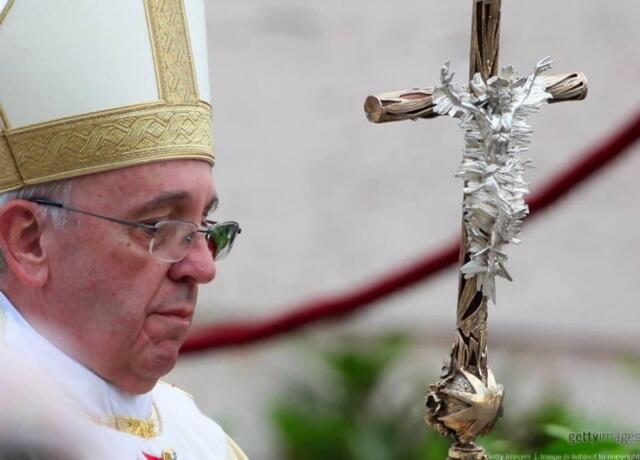
Pope Francis' Crozier


Some people don't like Pope Francis' new crozier.
It's too ugly, they say.

It is ugly.
So?

The Scriptures say that Jesus was so badly beaten that nothing about Him looked human, much less beautiful. Hanging on the Cross, He took on our sin. On the Cross, He looked to us like we look to God.

So, here are the questions:
Are you holy?
Would you look beautiful hanging on the Cross?

Maybe Pope Francis is showing us how ugly we look to God. Maybe, just maybe, God sent us Pope Francis because this Pope knows how to get under our skin, he knows how to remind us where we should turn our hearts.


Tuesday, October 01, 2013

Messianic Jews and Eating Kosher

A friend recently asked me a question concerning Messianic Jews and the necessity of eating kosher:
My nephew is a hard core Messianic Torah observer.   I've been able to refute just about everything he throws out there on Facebook but I can never really do well with all foods being clean.  I know that some Bibles state that Jesus made all foods clean in Mark, but some don't so I'm not sure if thats added.   He also has an answer for Peter's vision which I posted below as a meme.   I know that Jesus fulfilled the law but I'm not sure how to prove it in this case.  Any help would be appreciated.
The attached graphic says "Peter's vision in Acts 10 had nothing to do with eating what Scripture has always called an abomination. The vision had to do with MEN and Peter provides that interpretation in verse 28."

My Response:

When he interprets verse 28 that way, he's missing a point. He doesn't understand the different kinds of law and how they apply. From the Jewish point of view, for purposes of ritual, Gentiles are considered animals. For instance, in the orthodox rabbinic understanding, a Jew who marries a Gentile is considered to have married an animal for purposes of ritual and tracing descent.

This is the key passage from the linked webpage: "It is because in this legal dimension (marriage) they are both in the same category. In every other dimension, particularly in the arena of interpersonal dynamics, gentiles are compatible with Jews.  However, in the area of marriage, Jews and gentiles (or animals) can never be married as recognized by Jewish law."

Baptism is two things at once: it is both sonship in Christ and marriage to Christ. So, baptism establishes EXACTLY the relationships that the Talmudic Jews say CANNOT be established between a Jew and a Gentile. Baptism creates sonship and it creates a marriage bond between a Gentile and a Jew (Jesus). This is why Peter can interpret the vision as permitting baptism.

But notice that Peter doesn't understand this SECOND meaning of the vision until he encounters Cornelius. His first understanding is that he's allowed to eat formerly unclean foods. BOTH understandings are simultaneously true.

Just as the only thing preventing marriage between a Gentile and Jew is Mosaic ritual law, so the only thing that prevents anyone from eating "unclean" food is ritual purity as outlined by the Mosaic laws. Acts 10 helps us understand what Romans tells us: we are no longer under the Mosaic ritual law - we are under the law of Christ. I have an MP3 on how the law applies here.

As for a specific evidence that the laws of kashurt were suspended, consider Peter as he moves through Acts and into Galatians. At the beginning of Acts 10, Peter was still following the law of kashrut, because he even says it, "Lord, you know I let nothing unclean pass my lips." Then he has the vision in which God tells him that kashrut no longer applies. When Peter meets Cornelius in Acts 10, he suddenly realizes that what applies to food must also be true of the sacraments - a Gentile CAN marry and be a true son of a Jew.  So, Peter declares Cornelius eligible for baptism, even though Cornelius is a Gentile.

Now, fast forward to Acts 15. Both Peter and Paul testify to the baptisms they have been doing. The council not only agrees that Gentile baptism is acceptable, it also makes a point of describing the food that is to be avoided: "You are to abstain from food sacrificed to idols, from blood, from the meat of strangled animals and from sexual immorality. You will do well to avoid these things."

Notice it ignores most of the Mosaic laws on kashrut (clean and unclean foods). For the few foods that it does list, it does not command that these foods be avoided, it just recommends that they be avoided (you would do well). And two apostles are sent along with the text to make sure that the Jews who are following Christ can authenticate, by an oral tradition, the correct understanding of the written Scripture which comprises the message.

Now, fast forward again to Galatians. Why did Paul rebuke Peter? Because Peter had suddenly stopped eating with the Gentiles. Paul - a Pharisee - is not only reminding Peter that he should eat with the Gentiles, he is also thereby stating that the food which Gentiles eat is acceptable food.  All Gentile foods are clean.
Galatians 2: 12 Before some men who had been sent by James arrived there, Peter had been eating with the Gentile believers. But after these men arrived, he drew back and would not eat with the Gentiles, because he was afraid of those who were in favor of circumcising them. 13 The other Jewish believers also started acting like cowards along with Peter; and even Barnabas was swept along by their cowardly action. 14 When I saw that they were not walking a straight path in line with the truth of the gospel, I said to Peter in front of them all, “You are a Jew, yet you have been living like a Gentile, not like a Jew. How, then, can you try to force Gentiles to live like Jews? 15 Indeed, we are Jews by birth and not “Gentile sinners,” as they are called. 16 Yet we know that a person is put right with God only through faith in Jesus Christ, never by doing what the Law requires. We, too, have believed in Christ Jesus in order to be put right with God through our faith in Christ, and not by doing what the Law requires. For no one is put right with God by doing what the Law requires.
When speaking of what the Law requires, Paul is specifically speaking of the Mosaic laws, laws which include the laws of kashrut. So, Paul is specifically telling us that the law of kashrut no longer applies. The Mosaic law is now a dead letter. Paul talks about the Law being of no force precisely in the context of Peter taking meals with Gentiles.

The Messianic Jews are wrong to follow the laws of kashrut. There is no longer a difference between clean and unclean foods. All foods are clean.

Rod Dreher: Crunched In The Head

Many Catholics today are getting upset about Rod Dreher's insistence that he can't return to the Catholic Church because it is too touchy-feely. He'll stick with the Orthodox church because it "teaches the hard lessons."

Yes, it is hard to read the sentence above without snorting.
Now I hate the sugary sweet sermons and spinelessness of American Catholics as much as the next guy, but let's get serious.

The Orthodox Church accepts divorce and contraception.

If Rod Dreher was REALLY looking for doctrinal rigor, he wouldn't be Eastern Orthodox.

Now, I'm quite certain he is being honest when he says he can't bring himself to return to the Catholic Church. But I'm also sure that the problem isn't the treacle that American Catholic priests commonly mistake for preaching. God bless his little heart, as they say in Texas, but Rod didn't get where he is today by disagreeing with the mainstream media. His incoherent essay just proves that point again.


Distributism Doesn't Work

Distributists like to say that if we all just reverted to the views of a couple of men who knew little to nothing about economics, the world would be better off.

It's been tried.
It has failed.

Unless someone can find an equally large scale experiment in which thousands of businesses built on the small, work-at-home model actually succeeded, there isn't much more to discuss.

Most people are not psychologically prepared or equipped to run their own business. Just as running a major corporation takes a certain kind of personality, so does running a small business. Not everyone has the right personality. It is foolish to think even a majority of people do. Distributism doesn't work.

Tuesday, September 24, 2013

Why Popes Make Lousy Economists

Pope Francis recently opined: "We don't want this globalised economic system which does us so much harm. Men and women have to be at the centre (of an economic system) as God wants, not money."


Unfortunately, the globalised economic system he decries has raised the standard of living for every person on the planet in the last two centuries. We have gone from a planet of 1 billion people in the year 1800 to over 7 billion in the year 2013 - an increase of roughly six planet's worth of population - while feeding, clothing and housing all seven planet's worth of population to a level that essentially no one had in the 1800s. Certainly, he knows this. So what is he complaining about?

Economy: A Two-Fold Purpose
The global economy serves two purposes: (1) the work it creates provides us the income to maintain physical health and well-being, (2) that same work provides us with dignity and a sense of self-worth for the soul. However, we no longer seem to be able to provide both at once.

Before the Industrial Revolution, nearly everyone worked because universal work was necessary for society to survive. In a subsistence-level society, community survival walks on the edge of a knife. The failure of even one person to work, the failure of even one person to in some way provide sustenance for himself and his family, could easily be the straw that broke the community's back. That one last bushel of missing grain might turn out to be the missing calories that condemn the entire community to starve in the last few days before harvest.

For most of human history, every person's contribution to the community, no matter how small, really did count. Everyone mattered. Thus, man has historically always tied work with a sense of self-worth. But what happens when technology enters the picture? Physical comforts increase, but work, and the self-worth it generates, disappears.

Technology, Poverty and Dignity
In the Middle Ages, Europeans invented the horse collar. The horse replaced the ox as the main source of power to plow fields. Because horses work 50% faster, fields could both be plowed more efficiently and be located farther from urban centers. Half of Europe had been wilderness, but it could all now be plowed under. Europe's settled areas increased and population doubled, leading to the technological explosion that was the High Middle Ages. 

The Industrial Revolution replaced the horse with steam, then diesel, engines. But this time, there was no wilderness to plow under. That was already done. This time, something new happened. As agricultural output increased, farm jobs didn't increase. Instead, they dried up. The job market switched from agriculture to industry and manufacture, but population expanded faster than the job market. Something had to give. Something did.


The late 1800s invented, for the first time in history, child labor laws, intended to lock children out of the job market and decrease job competition for adults. It also invented retirement laws, wherein the government paid a wage to those over 65 in order to keep them out of the labor force. Children were told education was their job, they were forced into mandatory schooling. They were bored. Everyone, including children, began to understand that children were increasingly useless to the community. As children lost their jobs, children lost their dignity. As health conditions improved, population increased, but family size shrank. For the last 200 years, the overall production of children has steadily slowed. This is the demographic transition.

In the 1800s, as child production slowed, women were no longer needed in the home. As children lost importance and dignity, so did motherhood. Women began to move into the paid work force. In 1900, only 19 percent of women of working age were working or looking for work. In 2007, women represented 46 percent of people in the labor force.

By 1922, Henry Ford reduced the work week. He proved the automated production line took jobs and never gave them back. Production increased even though the work week was now only five days long, eight hours a day. What happened to agriculture now happened in manufacturing. Just as the engine had done with agriculture, automation reduced the number of jobs while vastly increasing manufacturing output.  Industry accounted for about 10% of the workforce in 1800, reached a high of 35% around 1955, and has been steadily declining ever since, dipping to less than 9% today.  

A society that was 95% agricultural in 1800 is now less than 2% agricultural, yet produces six-fold more food. Over one-half of US industrial jobs since 1980 have disappeared, yet we manufacture twice as many products. Mechanization has replaced, is replacing, both slave and wage labor. In each generation, fewer adults in any society need work to eat. The ancient Roman Empire used slave labor everywhere, but could only afford to give bread away in the capitol, not empire-wide. Even with pagan Rome's dignity-destroying slavery, there was not enough bread. The Industrial Revolution took jobs but gave bread. 

It invented the both five-day work week and the modern welfare state.  Now, all the poor throughout the nation, even throughout the world, can be fed, clothed and housed, and they are. But they have no jobs, no dignity. It will only get worse.

3-D Printing and The Future
3-D printing will destroy manufacturing in every form. It is currently possible to 3-D print an entire house, plane, a rocket engine, even food. Costs are currently high. Costs will drop. As costs do, as people gain the ability to produce items on their 3-D printers as easily as they now search for information on the web, jobs will continue to disappear. But physical poverty will not re-appear. As physical poverty disappears, moral and ethical poverty will only increase.

The job market now centers on information. By definition, one-half of the population has an IQ below 100. Thus, one-half of the population cannot be retrained to join the new job force. Automation has taken 98% of the farm jobs. It has taken, or will take, 98% of the manufacturing jobs. There are no jobs, and thus there is no dignity, for one-half of the population. One-half of the normal distribution curve is now, or will soon be, labelled useless.

Already, children have lost so much dignity that some segments of the population see no moral or ethical problem with cutting them up, alive, and selling their body parts. The sick and aged are encouraged to kill themselves via assisted suicide laws. Far from participating in the harvest, the "useless" are the harvest. As we have grown rich, we have grown cold.

Society can feed, clothe and house all of us. We will not be physically poor, but half of us will not have work. We will have to gain our sense of dignity from something other than work. No one knows how to do that.

The Paradox the Pope Poses
This is the paradox the Pope poses to us. Pope Francis hates poverty, whether it be of body or soul. He wants the poor to be fed and clothed, but he also wants them to have dignity, and the only way he knows how to do that is to make sure they are employed.

Pope Francis hates the welfare state nearly as much as he hates abortion. But. currently, he can't have it both ways. Personnel costs are the highest component cost of any product. We can't give the poor both food and jobs.The same global economy that has functionally removed physical poverty from society has also functionally removed the dignity of work from society. Can we give them food and dignity? Perhaps. But we don't know how.

We already recognize that technology has separated procreation from sexuality. Technology removed dignity from children and the aged. With children and parenting devalued, it also removed dignity from sex. The Catholic Church has not figured out how to make people recognize and correct the loss of dignity in any of these areas. Catholics know this is a problem, but we can't convince anyone else that it is.

What the Pope and most other Catholics don't yet fully realize is this: technology has also separated poverty, dignity and work. One-half of the population has become a parody of what P.G. Wodehouse himself parodied in Wooster and Jeeves: we now have an entire class of men and women who do not derive their dignity from their work. However, unlike Wooster, neither do our men and women derive their dignity from their social status. They have neither employment nor social status. Thus, they have no dignity.

Technology has given them their creature comforts but has taken both their jobs and their dignity. As with the children a century ago, these adults will be well-fed, but they won't be getting their jobs back.

It isn't the worship of money that lies at the bottom of this morass. It is the inexorable advance, the universal embrace, of the labor-saving machine. Our problem isn't capitalism per se, nor has Pope Francis said that it is. Our problem is the loss of dignity.

If the Pope can't get people to stop using condoms, how likely are they to stop using their cell phones? Who is going to return to the labor-intensive card catalog and paper phone book, much less the labor intensive spinning mill, when a 3-D printer can produce whatever you need at the push of a button? How many people will trade their fully laden table, their air-conditioning, automobile, smart phone and Internet access for the dignity of a job, especially if by gaining the job, you had to surrender any guarantee that you could still keep the creature comforts just listed?

Worse, what does it mean to say "the dignity of a job"? What constitutes work? What most "information workers" do today isn't what we have historically considered to be work. They don't break a sweat or a finger. No matter how hard they type, they don't get a callus. They sit in air-conditioning, eat snack foods, drink fizzy flavored water, never worry about cholera or typhus, never slap a mosquito or burn off a tick. The dignity of work has changed. It is changing again.

The Pope said, "Where there is no work, there is no dignity." Technically, we know that bare phrase is untrue - each of us has dignity because we are each an image of the Persons of the Godhead. What he means is, society doesn't assign dignity to those who do not work. This is also true, but it doesn't address the basic issue. The problem of physical poverty is essentially solved. We must decide if dignity is inextricably and uniquely attached to work. For if we want people to have dignity in secular society, we may have to find a new way to derive it.

Sunday, September 22, 2013

Creationism and Geocentrism

Recently, our pastor announced that the parish was inviting in Hugh Owen, defender of Creationism and main speaker for the Kolbe Center for the Study of Creation, to give a parish talk on what he and Mr. Owen consider to be a doctrine of the Church. Given what I have written in the past, this piqued my interest. Much as I would have loved a personal conversation on this topic, I am unable to attend the talk due to a previous engagement. So, I sent his institute a question on their contact form:
Do you teach geocentrism as well? It is attested to by all the Doctors of the Church, so I'm certainly hoping you do.
This was his reply:
Please forgive me for taking so long to write back to you.

Many of our members are geocentrists, but not all, mainly because we have concentrated our efforts on educating people about the doctrine of creation rather than the geocentric controversy.  However, all of us who have looked into the matter agree with you and do not shy away from saying so when the topic arises.

One of the main tenets of traditional Catholic theology that has been almost completely abandoned in our time is the distinction between the order of creation and the natural order of providence which only began when the work of creation was finished with the creation of Adam and Eve.  Atheistic and theistic evolutionism are both based on the false premise that one can extrapolate from the natural order of providence in which we live all the way back to the beginning of creation--and that is false.  Thus, all forms of evolutionism are based on a fundamental error.  The relations among the Earth, the sun and the planets in the solar system on the other hand is a part of the natural order of providence and is thus a legitimate object of study for the natural scientist.  This is one of the main reasons why we do not place the Church's traditional position on geocentrism in the same category as her dogmatic teaching on creation which concerns things which are beyond the legitimate ken of the natural sciences.

Please keep the Kolbe Center in your prayers.

                                   Yours in Christ through the Immaculata,

                                                        Hugh Owen
So, apparently the existence of human persons is not part of the natural order of providence, while the relations among heavenly objects is part of the natural order of providence. 

Now, if we "cannot extrapolate from the natural order of providence in which we live all the way back to the beginning of creation", then presumably we cannot extrapolate a Big Bang, nor any universe that is not geocentric. But he also says that the relationship between heavenly bodies is "a legitimate object of study"...

So which is it? If we can study the relationship between heavenly bodies, then it would be possible to do so all the way back to the beginning of creation. Certainly the planets were created before Adam and Eve. But he denies that we can go all the way back to "the beginning of creation." Now, what constitutes the beginning? Does he mean "Let There Be Light"? Or does he count the whole "six days" of creation as one unit, and therefore mean we can only go back to just after the creation of Adam and Eve? If the latter, then when it comes to studying the relationship of heavenly bodies, he is saying both "no" and "yes" in the same answer. 

And, notice, the question I asked concerned geocentrism - the question of whether the earth is at the center of the universe, not just at the center of the solar system (which, if Mr. Owen were correct about geocentrism, would render his "solar system" phrase itself erroneous, but I digress), so his answer is somewhat contradictory. His response seems to imply that his members teach the earth is at the center of the "solar system" and at the center of the universe, simultaneously. If so, this is a brand-new model. Even Tycho Brahe didn't attempt to prove both could be simultaneously true.

Finally, if he does teach geocentrism as well as creationism, why not proudly put both on the website so that the necessary distinctions between natural order of providence and the supernatural order of providence could be made clearly? Why would I have to send him an e-mail to discover that he teaches geocentrism as well as creationism? 

Here is my reply:
I'm afraid you mistake me, sir.
I agree with neither creationism nor geocentrism.
However, I *did* very much hope that you were logically consistent enough to recognize that to insist on creationism is necessarily to insist on geocentrism, for the foundation of one subsumes the other.

I just wanted your response so I could make it public. As you aver, none of your group shies away from saying so when the topic arises. Thus, I am somewhat saddened that your institute does not publish your geocentric views anywhere on your site, at least not as far as I can see. If you do have a link to a page on your site where you make your full position clear, that would be most helpful.
If you would like to have a public conversation on the topic, you may feel free to reply on this website:
http://skellmeyer.blogspot.com/2013/09/creationism-and-geocentrism.html 
 Thank you for your reply!
Steve Kellmeyer


Thursday, September 19, 2013

Pope Francis and Hot-Buttons

"In the history of salvation, God has saved a people. There is no full identity without belonging to a people. No one is saved alone, as an isolated individual, but God attracts us looking at the complex web of relationships that take place in the human community. God enters into this dynamic, this participation in the web of human relationships."
The sentences above represent the heart of what Pope Francis has to say. These are what makes sense of everything else.  
“The church sometimes has locked itself up in small things, in small-minded rules. The most important thing is the first proclamation: Jesus Christ has saved you. And the ministers of the church must be ministers of mercy above all. The confessor, for example, is always in danger of being either too much of a rigorist or too lax. Neither is merciful, because neither of them really takes responsibility for the person. The rigorist washes his hands so that he leaves it to the commandment. The loose minister washes his hands by simply saying, ‘This is not a sin’ or something like that. In pastoral ministry we must accompany people, and we must heal their wounds.
When talking of confessors, as he does above, he gets specific. In the passage above, he tells us why he is wary of the traditionalist, the rigorist. He also tells us why he defrocked an Argentinian priest for promoting homosexual marriage. 

He is not denying the moral or dogmatic teachings of the Church. He's saying that the current methods for trying to help people embrace these teachings do not work:
The proposal of the Gospel must be more simple, profound, radiant. It is from this proposition that the moral consequences then flow.
He's absolutely correct in every detail. But he isn't finished:
A beautiful homily, a genuine sermon must begin with the first proclamation, with the proclamation of salvation. [emphasis added]There is nothing more solid, deep and sure than this proclamation. Then you have to do catechesis. Then you can draw even a moral consequence. But the proclamation of the saving love of God comes before moral and religious imperatives. Today sometimes it seems that the opposite order is prevailing.
But that is nothing compared to this:
The complaints of today about how ‘barbaric’ the world is—these complaints sometimes end up giving birth within the church to desires to establish order in the sense of pure conservation, as a defense. No: God is to be encountered in the world of today.
“God manifests himself in historical revelation, in history. Time initiates processes, and space crystallizes them. God is in history, in the processes. [emphasis added]
“We must not focus on occupying the spaces where power is exercised, but rather on starting long-run historical processes. We must initiate processes rather than occupy spaces. God manifests himself in time and is present in the processes of history. This gives priority to actions that give birth to new historical dynamics. And it requires patience, waiting.
...in this quest to seek and find God in all things there is still an area of uncertainty. There must be. If a person says that he met God with total certainty and is not touched by a margin of uncertainty, then this is not good. For me, this is an important key. If one has the answers to all the questions—that is the proof that God is not with him. [emphasis added] It means that he is a false prophet using religion for himself. The great leaders of the people of God, like Moses, have always left room for doubt. You must leave room for the Lord, not for our certainties; we must be humble. 
There is too much brilliance in this interview. I can quote no more. You must read it.

UPDATE:
And for those who think Pope Francis has gone soft on life issues, read today's remarks.
Here's a similar link.

Keep in mind, this man wants union with the East. Eastern Catholics permit contraception. How can he get the EO bishops to at least privately admit that contraception is a bad idea? Well, first he has to give them public reason to talk to him. The whole interview revolved around his openness to dialogue.

The Pope isn't just talking to Americans or Europeans. He is always talking to the whole world. He knows that, even if we forget it sometimes.

Scriptural FourSight Scripture Project Launched!


Please take a look and contribute if you can.


Thursday, September 12, 2013

Child Abuse in California

California has now passed a law lifting the statute of limitations on child abuse claims. The law specifically retains the statute of limitations for public schools and other government entities. The government can abuse your children, private citizens cannot.

Why not lift the exclusion for public schools as well?

Here's your answer.
You should especially like this sub-link, where the GAO finds sexual abuse by public schools and subsequent hiding of the abuse to be a NATIONAL problem.

According to a report commissioned by the U.S. Department of Education, in compliance with the 2002 "No Child Left Behind" act signed into law by President Bush, between 6 percent and 10 percent of public school children across the country have been sexually abused or harassed by school employees and teachers.

Here's The Economist on the New York habit of "passing the trash" - covering up teacher sexual abuse, along with the money quote:
A 1995 study of 225 cases in which pupils were sexually abused by teachers or other staff members found that in only 1% of the cases did the school-district superintendent attempt to revoke the culprit's teaching licence.
Education Week ran a six-part story on it in 1998, with an update in 2003.

Here's a DOE synthesis study

That's what I found on Google in 60 seconds.
There is a lot more.
Just google "passing the trash sexual abuse public schools" or "sexual abuse public schools".

The Angler Fishes For Atheists

The Pope wrote a letter to an atheist that seems to have stirred up the secular press, and no few number of traditionalists. The full text of the letter can be found here.

It's a brilliant reply to an avowed atheist.
Francis doesn't begin by refuting the atheist, he begins by thanking the atheist for being willing to even discuss it. He follows by giving a personal witness of why the Faith matters to him. 

He then moves the conversation from a discussion of the points the atheist is concerned with to the central problem: Who is Jesus?

Only after he deals with this central question does he move to deal with the questions the atheist raises. The heart of the answer he gives the atheist lies in this section:

First of all, you ask if the God of the Christians forgives those who do not believe and do not seek faith. Given that - and this is fundamental - God's mercy has no limits if he who asks for mercy does so in contrition and with a sincere heart, the issue for those who do not believe in God is in obeying their own conscience. In fact, listening and obeying it, means deciding about what is perceived to be good or to be evil. The goodness or the wickedness of our behavior depends on this decision.
Second of all, you ask if the thought, according to which no absolute exists and therefore there is no absolute truth, but only a series of relative and subjective truths is a mistake or a sin. To start, I would not speak about, not even for those who believe, an "absolute" truth, in the sense that absolute is something detached, something lacking any relationship. Now, the truth is a relationship! This is so true that each of us sees the truth and expresses it, starting from oneself: from one's history and culture, from the situation in which one lives, etc. This does not mean that the truth is variable and subjective. It means that it is given to us only as a way and a life. Was it not Jesus himself who said: "I am the way, the truth, the life"? In other words, the truth is one with love, it requires humbleness and the willingness to be sought, listened to and expressed. Therefore we must understand the terms well and perhaps, in order to avoid the oversemplification of absolute contraposition, reformulate the question.
The Pope hits on precisely the problem: it is one of definition. In most cases, the atheist denies God because he misunderstands the meanings of the words being used in the conversation. Correct definitions, a correct understanding of exactly what is under discussion, is crucially important to see the crucis, the Cross.

And here the Pope merely repeats what the Church has always taught, what St. Paul wrote down in Romans 2:15, "Who shew the work of the law written in their hearts, their conscience bearing witness to them, and their thoughts between themselves accusing, or also defending one another." It is also a fine explication of the essence of the Catechism of the Catholic Church, #1950-1960, especially #1956.

God is Truth. Those who seek the truth, those who doubt the existence of God because they are afraid of being fooled, seek the Idol of the Unknown Name that Paul describes in the Areopagus. They know not Christ's name, but they know the importance of truth, the critical importance of seeking out the truth. And, as the Church teaches, it is their relentless search for truth that may save them. 


The FSSP and the Sadducees

A recent blog post describes the teaching of an FSSP priest who asserts that aborted babies do not go to heaven. The FSSP priest's erroneous teaching led the blogger to an extended, and unfortunately erroneous, meditation on why the lie taught by this "good priest" would be true.

The crux of the argument: while baptism of blood and desire exists, both require the use of reason. According to the priest's erroneous line of reasoning, since infants have not the use of reason, aborted infants cannot receive either baptism of blood or baptism of desire.

Furthermore, according to this priest's version of the Feeneyite heresy, if we were to assume that such babies were baptized by blood via their abortion, that would make abortion into a sacrament. The unfortunate blogger, a good man dazed by this dizzying line of clerical absurdity, labels the priest's reductio ad absurdem argument "irrefutable". 

Many unfortunate Catholics have fallen under the spell of this particular priest. Even though the blogger takes care to explicitly deny that this nonsense is dogma, his use of the word "irrefutable" implies that the blogger thinks the priest's false line of reasoning is of doctrinal quality.

Unfortunately for both the FSSP priest who teaches this error and the poor Catholics who follow his frequently erroneous reasoning, the liturgy of the Church specifically and explicitly denies the priest's entire line of thought.

Consider the feast of Childermas, the Massacre of the Holy Innocents. Note the word "Holy" in the title of the Feast. Childermas celebrates the entry into heaven of those infants slaughtered by Herod as he fruitlessly sought to murder the King of Kings. 

Those infants had not the use of reason. Their only virtue was to be slaughtered for a saviour whom even their own parents did not yet know, yet every irrational infant slaughtered by Herod and baptized only by his own life blood is celebrated by the Church as a saint in the heavenly choir.

Obviously, martyrdom is not a sacrament, yet according to the eternal liturgy of the Church, martyrdom sends people to heaven, even people who have not the use of reason. In fact, martyrdom is so effective at sending infants to heaven, that even the infant's parents need not know anything of Christ in order for the infant, slaughtered as a mute witness, to attain the heavenly kingdom.

Now, if we followed the "very good priest's" logic, we would be forced to conclude that infanticide is a sacrament. But I bet it isn't.

Like infanticide, like abortion, martyrdom is not to be sought, for it may send the one who murders the martyr to hell. Yet martyrdom may also bring about conversion in the murderer, and for this reason, the saint who is faced with martyrdom may embrace it, even embrace it joyfully, as long as he offers his death for the conversion of the one who murders him. 

We don't know what happens to innocents who die unbaptized. But the liturgy of Childermas gives us a solid hope, as does the infallible teaching of the Ordinary Infallible Magisterium. Any priest who says otherwise contradicts the infallible Church. Such a priest may be many things, but "good" is not one of them. 

When Jesus faced the Sadducees, he faced a group of men who accepted only the Torah as holy Scripture. Much as many traditionalists adhere only to the EF Mass and reject the OF Mass as somehow false or contaminated, the Sadducees refused to accept the prophets or the writings as inspired. Only the eternal Scripture of the Torah was good enough for them. 

Jesus used quotes from their own Torah to refute them, and admonished them by saying, "You are quite wrong. You know neither Scripture nor the power of God." 

Similarly, the Church, via Her liturgy, rebukes this "good priest" and uses the very EF liturgy he embraces to demonstrate his error. He is quite wrong. He apparently knows neither liturgy nor the power of God. 


UPDATE:
In fact, the CCC specifically denies that Limbo exists.

CCC 1283 With respect to children who have died without Baptism, the liturgy of the Church invites us to trust in God's mercy and to pray for their salvation.


It is a condemned heresy to say that you can pray for those who are in hell. Limbo, as is commonly envisioned, is the first circle of hell. If Limbo existed, then the CCC would be teaching heresy. The CCC is promulgated by an Apostolic Constitution, the highest expression of the Ordinary Infallible Magisterium. Thus, Limbo does not exist.

Wednesday, September 04, 2013

Syrian Chemical Weapons and Obamacare

Syria is one of five nations that never signed the Chemical Weapons Ban Treaty.
The Geneva Convention on which it is based only bans the use of chemical weapons by one state against another, it never actually banned the use of chemical weapons within a country's own borders against internal opposition.

So, Obama will bomb Syria for not having violated a treaty it never signed.

With ObamaCare, Americans are bombed with a tax for not having paid for insurance we never wanted.

Is there a pattern here, or is it just me?

Sunday, September 01, 2013

The Mystery of Chemical Weapons

OK, I'm officially mystified. I mean, I would be if I wasn't sure that Obama was a terrorist sympathizer at the very least.

But, Obama's response to chemical weapons use in Syria isn't what mystifies me. It's everyone else's response.

Everyone is yelping about this international chemical weapons ban being violated. Nobody seems willing to admit that the use of chemical weapons in this instance is not really the problem.

Now, let's leave aside the fact that no one really knows which side used the chem-weapons. Reports conflict. The Syrian rebels may very well have gassed their own people, either via an accident they were having with THEIR chemical weapons, or on purpose to make Assad look bad. They've done this kind of thing in the past - Muslims think nothing of using their own children to blow up the opposition.

But that's not the point.
Everyone is upset that civilians, especially children, were killed with chemical weapons. Since when did we become concerned about using the correct kind of violence when killing civilians, even civilian children, in a war?

Both Assad AND the rebels killed children with bullets and high explosives. Is this somehow saner and cleaner than killing them with chem-weapons? I don't get the logic - either way, you end up with a corpse.

The international chemical weapon ban was a ban on use against SOLDIERS. The idea is that we retain at least a modicum of chivalry in warfare. If you're going to fight somebody, at least give them a chance to fight back (artillery, and their drone-strike children, get a grandfather-clause waiver here).

NOBODY is supposed to be using ANY weapons against civilians. Yet EVERYBODY who fights Muslims uses weapons against civilians because Muslims are cowards who hide behind civilians every chance they get. Thus, there are something like 100,000 civilians dead in Syria. The vast majority were killed with conventional weapons, with a few thousand killed by chemical weapons. Yet somehow, the few killed with chemical weapons are more dead than the great mass who were killed by more conventional means?

Obama's "thin-red line", his grotesque "distinctions" - indeed, most of the commenters absurd "distinctions" - are just incredibly stupid. I use the word "stupid" instead of "ignorant" because these Ivy League graduates are supposed to already KNOW the distinctions between a civilian and a soldier. They are supposed to already KNOW that civilians aren't to be killed at all, while soldiers are to be targeted only with conventional weapons. If they don't know these differences, they must be stupid.

And how will we respond? By drone-striking Syrian targets. As the brilliant Sarah Palin points out, it isn't clear why us bombing Syrians is superior to Syrians bombing Syrians. I guess we just use morally superior high-explosives or something.

Saturday, August 31, 2013

Michael Voris and Catholic Answers

I have been asked my opinion on the Michael Voris-Catholic Answers dust-up.

Everyone seems to have an opinion about Catholic Answers, from Kathy Schiffer (who did not mention Michael Voris) to Dave Armstrong and Fr. Dwight Longenecker (both of whom most certainly did).

In order to be fully clear about my history with both, I have during the last 20 years applied for employment to Catholic Answers and been rejected. On numerous occasions I have proposed doing business with Catholic Answers on various things and been roundly rejected in the few instances when I have not been entirely ignored, which latter was much more frequent. Truth to tell, I almost never managed to get those guys to even return a phone call or an e-mail. It was worse than trying to work with EWTN, and attaining THAT level of inscrutable weirdness is really an accomplishment.

On the other hand, I have worked with Michael Voris and found him quite easy to get along with, extremely responsive and quite open to discussion. In fact, apart from one other individual who shall remain nameless, he's the only public Catholic I've had consistently positive experiences with. This is no small statement. I've worked with a lot of the big Catholic names, I've worked with some quite closely. Most of the "public Catholics", including myself, have some kind of ego problem - that's why we're interested in being in the spotlight, after all. And that undoubtedly plays into this whole kerfuffle.

Now, that having been said, I have benefited greatly from the work of Catholic Answers in general and Karl Keating's in particular. In fact, his work inspired my own first book.

I like both organizations and I see them both as having done great work.

All that having been said, the Catholic Answers supporters seem to be beating Voris up in a way that does not comport with the reality on the ground. I don't know why they are doing this.

Catholic Answers has obviously been around a lot longer, and perhaps that is why it has gone begging for money a lot more often than Voris' operation has. Does it need more money? I don't know. Certainly it is begging for money now.

So, what is my opinion?

I think Connecticut Catholic Blogger has done a MUCH better job of addressing this situation than I could. Given the evidence laid out there, I concur with Connecticut Catholic's most excellent assessment.

Voris hasn't said what most people attribute to him.
Catholic Answers and their supporters for some reason seem to want to make him their enemy.
And St. Jerome didn't get on very well with St. Augustine.

But I guess it generates website hits.
Whatever.

UPDATE:
I just noticed this passage in Fr. Longeneckar's post:
"The next problem with Voris’ attack is that his method is unscriptural. The Sacred Scriptures teach us that if you have a problem with your brother you are to go to them first in private. Did Voris sit down in a meeting with Keating, Kresta, Keck and the others? If he thought it was his business did he make an appointment and say, “Fellas, there are some criticisms about the level of your salaries, could we gather some more information?” I don’t know, maybe he did or maybe he simply got in front of the camera and started blasting away. "

Maybe? MAYBE? You mean, Father, that you DID NOT contact Michael Voris to find out?
Pot, meet kettle...


Wednesday, August 28, 2013

Hope and Change

"Do you know that Negroes are 10 percent of the population of St. Louis and are responsible for 58% of its crimes? We've got to face that. And we've got to do something about our moral standards.....We know that there are many things wrong in the white world, but there are many things wrong in the black world, too. We can't keep on blaming the white man. There are things we must do for ourselves." 
 
Dr. Martin Luther King Jr. 1961, quoted in the WSJ from a 1961 Harper's Magazine profile on MLK.


"...in 2006, blacks were 37.5% of all state and federal prisoners, though they’re under 13% of the national population. About one in 33 black men was in prison in 2006, compared with one in 205 white men and one in 79 Hispanic men. Eleven percent of all black males between the ages of 20 and 34 are in prison or jail.
From 1976 to 2005, blacks committed more than 52% of all murders in America. In 2006, the black arrest rate for most crimes was two to nearly three times blacks’ representation in the population. Blacks constituted 39.3% of all violent-crime arrests, including 56.3% of all robbery and 34.5% of all aggravated-assault arrests, and 29.4% of all property-crime arrests."


Manhattan Institute, 2008