Support This Website! Shop Here!

Thursday, May 31, 2018

Capitalism and the Free Market

Many people are under the false impression that "free market capitalism" is the only kind of capitalism there is. This is, of course, absurd.
"Capitalism is an economic system where private entities own the factors of production. The four factors are entrepreneurship, capital goods, natural resources, and labor. The owners of capital goods, natural resources, and entrepreneurship exercise control through companies." 
Capitalism is about the private accumulation of capital, and that's it. 
Supporters of capitalism insist that true capitalism requires small government, but that's not true. Consider how capitalism works. It is a given that if we have a truly free market, then some people will be more skilled at accumulating capital than others. Those more skilled people will accumulate more capital than the less skilled people. The more skilled people will soon discover that, in most cases, cooperation is more efficient at accumulating capital than competition is. The more skilled capitalists will find ways to cooperate with each other in order to increase their individual stashes. 
Thus, they will necessarily create a governing body, or series of governing bodies, to build their wealth. This is the point of creating everything from "industry standards" to cartels. These governing bodies cut down on competition and increase capital accumulation for the participants. Obviously, if there is an already existing governing body, the more skilled capitalists will co-opt it, because that "governing" body helps them cooperate efficiently. Besides, it is more efficient to take over an existing body than it is to re-invent the wheel, and capitalists are all about efficiency.
So, when I point out that capitalism necessarily co-opts government and increases its size, people deny this. They deny it despite the fact that we can see the revolving door between government and business in operation every day. This revolving door is a necessary consequence of capitalism at work - the successful capitalists use every means at their disposal to accumulate wealth, and one of those means is cycling their employees through government offices in order to control the rules and thereby increase their wealth.
Not only do people deny this perfectly obvious natural consequence, they then attempt to refute the big government point by saying big government is not conducive to capitalism because big government takes capital from people by force or threat of force via taxes. Well, sure it does. That's the point. But violence and the threat of force is not antithetical to capitalism. The point of capitalism is to accumulate capital. That's it. How you get the capital is a matter of indifference. 
This is the point people don't seem to get. They insist a free market is necessary to capitalism. That's simply false. A free market might be inherently capitalistic, but capitalism does not require a free market. While a free market is often the most efficient way to gather capital, it is not always the most efficient way to gather capital. Capitalism just cares about capital accumulation. How you get that capital is a matter of complete indifference. Just get it. 
There are endless examples of violence being an efficient way to gather capital. For instance, people forget that one of the reasons the US and the Soviets did so well economically after WW II, is that the winners STOLE virtually every industry that war-time Germany built. Now, obviously, the US did better economically than Soviet Russia, but Soviet Russia bought itself another four decades by being on the winning side, and that was due in no small part to successful use of violence. As part of WW II war reparations (yes, Germany had to pay WW II reparations), the Germans were forced to make in-kind payments to the US of $23 billion in 1945 dollars. This was paid in machinery and manufacturing plants. That's right. We got free machinery and manufacturing plants of leading German technology, factories dis-assembled in Germany, re-assembled in the US and used for decades by the US to increase our manufacturing capacity at Germany's expense (the Soviets did the same). Does anyone really want to argue this activity did NOT increase American capital accumulation? Seriously? War or peace, capitalism works fine, regardless. 
If an entrepreneur can find a way to get everyone to pay a portion of their income to him, then he accumulates capital, he is a successful capitalist. Whether the people WANT to hand over the money is completely irrelevant to the successful capitalist. Whether the threat or fact of violence is involved is also completely irrelevant. As Clausewitz rightly points out, war is just the continuation of politics by other means. The corollary is obvious: violence is just the continuation of capitalism by other means. This is why capitalists have no serious objection to war. It is also  why the US has been involved in nearly continuous conflict since pretty much its inception.
Now, is socialism any better where violence is concerned? No, obviously not - in fact, it is MORE violent. But, from a capitalist point of view, the problem with socialism isn't its violence as much as it is the fact that socialism just isn't very good at accumulating capital.
Socialism uses economic tools (whether those be violent or not) inefficiently. Efficient use of violence is perfectly in harmony with capitalism, and whoever uses the various economic tools available most efficiently (which is defined as, whoever accumulates capital most efficiently) is, by definition, a great capitalist. Sometimes violence, or its threat, is going to be the most efficient way to build capital, as the corporate use of government to gather funds via taxes clearly demonstrates.

So, capitalism breeds big government. Government, big or small, is a perfectly legitimate economic actor. A free market is not necessary to the accumulation of capital, so arguing that government taxes interferes with the free market may be true, but it has no bearing on the discussion. Insofar as big government efficiently accumulates capital, every good capitalist will want his or her corporation to be a line item in big government's budget so s/he always get a cut of the accumulated capital in the pot.

The free market may lead to capitalism, but efficient capitalism does not lead to, or even necessarily want, a free market. Anyone who insists on having both at the same time, by that fact, necessarily insists on HINDERING one method to accumulate capital. In that sense, "free market capitalism" is a contradiction in terms. 

Monday, May 21, 2018

Three Questions

Some people are upset because Pope Francis reportedly told a homosexual "God made you like this and loves you like this". For those people who are upset, I have three questions for you:
  1. Did God make you?
  2. Do you suffer from the consequences of original sin?
  3. Does God love you, even though (2) is true?
If you can answer "yes" to all three of those things, then... how is this man different from me or you in that regard?

The MSM doesn't understand how this all works, so they draw the wrong conclusions. They incorrectly think that just because God loves the broken me, He doesn't want me to be healed. God loves me too much to want me to stay in this condition. He wants me to change. That is what the sacraments are for.

The MSM thinks Pope Francis is saying homosexuality is fine.
In fact, Pope Francis is reminding the man that the whole world is broken, and that we are part of that broken-ness. We all need to be healed.

That is the point of religion.
That is the point of Catholicism.

Tuesday, May 15, 2018

The Silence of the CABs

Catholic-American bloggers are strange beasts. Many of them went absolutely bonkers about Alfie Evans. They were insanely set on an amazing set of ideas:

  • parental rights are absolutely absolute, 
  • the state has no right whatsoever to step between a child and his parents, 
  • parents have the right to take their child to any country in the world if those parents believe there is even the smallest chance of improving the child's life. 
  • Even if the travel puts the child at grave risk of death, SCREW IT! Those parents have the right to do it!
So, Father Longenecker, EWTN, National Catholic Register, Rod Dreher (alright, he isn't Catholic, but still)... all of these and many, many more went absolutely bonkers insisting on some or all of these points. Anyone who even quietly attempted to moderate a single one of the points above was immediately attacked as a pro-abort, socialistic Democrat anti-Catholic hate monger who wanted a nanny state to replace legitimate parental authority.

Well, Catholic-American bloggers are nothing if not consistent. When the news came out that President Donald Trump's MAGA government explicitly and emphatically
  1. denied that parental rights are absolutely absolute
  2. insisted the state has every right to step between the child and his parents, 
  3. reviled the idea that parents have the right to take their children to other countries
  4. and argued that the very trip itself was simply too dangerous for the child, so the government has the right to actively kidnap the child and keep the parents from ever seeing their own child again...
... well, of course the Catholic blogosphere exploded! Articles came out in TheFederalist.com, National Review, National Catholic Register and Reporter. EWTN's Raymond Arroyo castigated the president as an out-of-control socialist. Rod Dreher attacked Trump's assault on the family. Father Longenecker lamented the putrid anti-Catholic malfeasance flowing like an open latrine from the Oval Office.

Right? Right!?!

Wait... What.....???

What do you mean all of those CABs are silent as the grave?
But... but.... but... consistency!
Catholic values!
Parental RIGHTS!?!?!

What about parental rights?
I mean, even the British didn't take Alfie away from his parents. They just wouldn't let Alfie on a plane, lest he die... too dangerous, in the government's view. But even the British never denied the parents access to their own child.

Trump, on the other hand, is actually snatching the kids, separating the families, making sure the parents never see their own children again. And doing this not just to one child, but thousands of children, not just one set of parents, but thousands of parents, not just one family, but thousands of families. The regular snatching of children away from their parents is now an exercise of official American government policy.

Sooo.... what happened to all that noise about Catholic Family Values (tm)?
Where did those click-mongers disappear to?

Oh... that's right.

For "conservative" Catholic Americans, Catholic values are disposable horseshit compared to the value in protecting Trump's legacy. That's what American Catholic Bloggers think. That's how they treat the Trumpian nightmare versus Alfie's nightmare. Trump is kidnapping the children of a bunch of Catholic Mexicans, but screw our brothers and sisters in the Faith. We support TRUMP, dammit, not a bunch of sniveling brown-skinned Catholics!

People sometimes question why I never read anyone in Catholic media.
The blow-up over Alfie vs the silence over Trump... yeah, that's why.


Wednesday, May 09, 2018

Prostitutes and Liturgy

So, some people are getting all worked up about the Met Gala Catholic theme. Seems a lot of Hollywood types dressed up in Catholic liturgical garb and pranced around in it as if it were Halloween.

I will ignore the easy gasp of "cultural appropriation!" and stab a bit deeper.

Consider the Catholics who habitually host a seder meal during Holy Week. Do you honestly think that puts an indulgent smile on the face of any orthodox Jew? Why aren't Catholics equally outraged at Anglicans? The Anglicans have, for centuries, been doing the same thing Hollywood just did. Anglicans dress up in Catholic liturgical garments, pretend to have a valid Mass, put women in liturgical garb and call them bishops, Anglicans essentially ape Catholic sacraments and liturgy. For centuries, we Catholics have let the Anglicans slide, so it's hard to see why we should get worked up about Hollywood. After all, it isn't like Hollywood is holding a fake Mass or attempting to ordain women. As travesties go, this is pretty tame.

Besides, lots of people dress up like the Kardashians, get their hair done like Jacqueline Kennedy, or make themselves up to look like Taylor Swift. They do this because they like something about those people. Even the black-face minstrel shows were an homage to the musical talent in the American black community.  Heck, Barack Obama was essentially eight entire years of a white guy in black face playing to a minstrel show crowd, and nobody even noticed.

America does this kind of thing all the time. Sure, this time Catholics were the meme. Next week, it will be blacks or Indians or Jews. That's just how our elite rolls. They say they hate population X, they say population X is not relevant, it's old-fashioned, it's out of step, it's archaic, yada. Then they spend part of their lives trying to be X.

Reminds me of the prostitute who boarded a ship filled with men on pilgrimage to Jerusalem. She seduced every man on board, got to the holy city, saw a vision of Mary, converted, became a desert hermit and eventually a saint, Saint Mary of Egypt. True story.

And if she had been forbidden to board that ship filled with Catholic pilgrims, she might never have converted. Things don't always work out the way you think.

So, let 'em dress up.
But go long on tickets to a cave in the wilderness.
God has plans.
Heheheheheh.

Friday, May 04, 2018

Equality: A Uniquely Christian Concept

We hold these truths to be self-evident, that all men are created equal, that they are endowed by their Creator with certain unalienable Rights, that among these are Life, Liberty and the Pursuit of Happiness. That to secure these rights, Governments are instituted among Men, deriving their just powers from the consent of the governed;
Many people consider these stirring words from the second paragraph of the Declaration of Independence to be the centerpiece of Western civilization. They are not wrong. It is the centerpiece of Western civilization because the phrasing is virtually a direct quote of Christian Scripture.
There is neither Jew nor Gentile, neither slave nor free, nor is there male and female, for you are all one in Christ Jesus. (Galatians 3:28). 
Up to the appearance of Christianity, no culture on earth held all of these ideas together at the same time. For instance, every human culture in existence, including the Jews, held slaves. Every human culture, including the Jews, considered itself specially endowed. Every culture considered all other cultures inferior, not equal. Most cultures even had a hierarchical system of categorizing its own population, the most well-known being the Hindu caste system. But the Hindu system was certainly not unique, it has simply proven to be the among the most strict and long-lasting.

There was only one pre-Christian attempt to assert the equality of individuals. Buddha's philosophy held that all were equal. Unfortunately, Buddha said individual equality was attained only because individuals really didn't exist at all. From the Buddhist perspective, there is no such thing as a human soul nor a Creator. Personal existence is an illusion. The goal of Buddhism is to attain the Buddhist version of nirvana, in which even the illusion of the individual ceases to exist at all. Buddhism is about self-annihilation - that is how it attains ultimate equality.

So, the Declaration of Independence summarizes a uniquely Christian set of concepts:
  1. "all men are created equal..."  (You are all one in Christ Jesus, Galatians 3:28)
  2. "they are endowed by their Creator with certain unalienable Rights..."  (Defend the poor and fatherless: do justice to the afflicted and needy. Psalm 82:3)
  3. "among these are Life..."  (God is the author of life - Acts 3:15)
  4. "Liberty..."  (Now the Lord is the Spirit, and where the Spirit of the Lord is, there is freedom. 2 Cor 3:17)
  5. "and the Pursuit of Happiness..."  (With joy you will draw water from the wells of salvation. Isaiah 12:3)
The phrases in the Declaration resonated with the West because these phrases were just paraphrases of Scripture itself. Catholic Faith and the Christian Scripture written by the Church are the foundation of Western Civilization. But because the Declaration's phrases are paraphrases, we tend to lose sight of Scripture's point: Scripture was most assuredly NOT describing some kind of physical equality between individuals. Rather, it was describing a uniquely Christian theological idea: everyone has an equal chance at salvation.

Again, no theology had ever said this before, and none have since either. Consider: the afterlife is not a source of major concern for Jews, because it is a given that all Jews, no matter how bad, will rejoin the nation of Israel. For the Jews, that is heaven. Only Jews get resurrected. Righteous Gentiles are, at most, ghost-like beings who can watch the joy of the re-unification of Israel without being able to fully participate. Similarly, all Muslims go to Paradise, even if they have to spend some time in hell to atone for their sins.

For Hindus and Buddhists, the point of the afterlife is to be obliterated, annihilated, to lose all sense of individual self. Hindus get absorbed into the single, all-pervading Being, Buddhists evaporate into nothingness.

Jews and Muslims rejoin their respective nations, Buddhists and Hindus disappear, but none except Christians assert the ability to live with God Himself. Only Christians do that, and only Christianity says everyone has the same opportunity to do that.

But what about physical equality? Yeah, no. Christian Scripture recognizes what everyone else recognizes: there is no such thing as physical equality nor is there physical equality of outcome. As anyone with breath in their body knows, there is a hierarchy among men that cannot be airbrushed away:
And God has placed in the church first of all apostles, second prophets, third teachers, then miracles, then gifts of healing, of helping, of guidance, and of different kinds of tongues. (1 Cor 12:28)
Our lives are bound together, but we do not have the same abilities, no matter whether one considers physical or spiritual abilities:
15 Now if the foot should say, “Because I am not a hand, I do not belong to the body,” it would not for that reason stop being part of the body. 16 And if the ear should say, “Because I am not an eye, I do not belong to the body,” it would not for that reason stop being part of the body. 17 If the whole body were an eye, where would the sense of hearing be? If the whole body were an ear, where would the sense of smell be? 18 But in fact God has placed the parts in the body, every one of them, just as he wanted them to be. 19 If they were all one part, where would the body be? 20 As it is, there are many parts, but one body.

21 The eye cannot say to the hand, “I don’t need you!” And the head cannot say to the feet, “I don’t need you!” 22 On the contrary, those parts of the body that seem to be weaker are indispensable, 23 and the parts that we think are less honorable we treat with special honor. And the parts that are unpresentable are treated with special modesty, 24 while our presentable parts need no special treatment. But God has put the body together, giving greater honor to the parts that lacked it, 25 so that there should be no division in the body, but that its parts should have equal concern for each other. 26 If one part suffers, every part suffers with it; if one part is honored, every part rejoices with it. (1 Cor 12:15-26).
One of the great mysteries that Christ Jesus resolves is this: He manages to provide the possibility of equal salvation outcomes even though we all are acknowledged to start with absolutely unequal physical, and even unequal spiritual, abilities.
Now there are varieties of gifts, but the same Spirit (1 Corinthians 12:4)
Yet while we are all united with God in heaven, even there we see a hierarchy.
I heard a sound from heaven like the sound of rushing water or a loud peal of thunder. The sound I heard was like that of harpists playing their harps. They were singing [what seemed to be] a new hymn before the throne, before the four living creatures and the elders. No one could learn this hymn except the hundred and forty-four thousand who had been ransomed from the earth.These are they who were not defiled with women; they are virgins (Revelations 14:2-4)
There are hierarchies among the angels (nine ranks of angels, with the seraphim being the closest to God) and among men. We have an equal shot at salvation, but even the saved have different rankings, different outcomes.

The problem Jefferson and other Enlightenment thinkers faced, the problem that they simply couldn't resolve, is now obvious: if you deny that God exists, or deny that Christ is God, then you are stuck with a concept, "all men are created equal and endowed... (the ellipse is important here) with certain inalienable rights." But, if there is no God, that sentiment cannot possibly be true.

It is absolutely obvious that all men are NOT physically, intellectually or spiritually equal. Some people are stronger, others weaker, some smarter, others less, some have more patience, kindness, virtue, others have less of all of these... well, I would have said "gifts", but if there is no God, then these aren't gifts, so... others have more or less of these "characteristics." If there is no God, if there is not "the same Spirit", then it is manifestly stupid and absurd to say "all men are created equal." You have absolutely no evidence for the proposition, and every comparison between any two people is evidence against.

Only the insane would argue all are created equal physically or spiritually.

"Well," the liberal might reply, "all persons have the same rights, at least!"
Really?
Why would they?

If there is no God, then it is equally impossible to argue that everyone should have the same rights. After all, if God created all of us and God has the same intention for all of us (union with Him), then we can argue that we all have the same rights. In fact, God will have given us all at least one right that is identical: the right to secure a place in heaven has to be identical, and therefore any right that helps us secure that place has to be identical to all. We must all have those rights necessary to attain our single goal.

But if there is no God... that changes everything. If there is no God, then only an insane man or a comic would even present the argument that all men are, in any way, created equal. Even Monty Python's Flying Circus recognized that fact:


But insanity was Thomas Jefferson's way. The author of the Declaration of Independence simultaneously insisted that he was a good Christian, a good follower of Christ Jesus while also insisting that Christ was not God, but merely an excellent moral teacher. As C.S. Lewis points out, those two ideas cannot be held simultaneously. Christ was either a liar, a lunatic or the Lord. If He was not the Lord, then He was not a great moral teacher because His assertions become ludicrous. If Christ is not God, then Christ's teachings become impossible to logically reconcile together.

Unfortunately, Jefferson followed the great Protestant tradition of cutting out all those parts of Scripture he didn't like. Jefferson was also prudent enough to refrain from telling very many people that he didn't believe Jesus was God. Thus, Jefferson was never required to face how ludicrous his position actually was. Unfortunately, because he never faced his lunacy, most other people haven't recognized his lunacy.

As a result, everyone who has subsequently built within Jefferson's Potemkin village has faced the problem Jefferson refused to recognize: without the context of Christian belief, the Declaration of Independence is an absurd document. If Christ is not God, then the Declaration, and the Constitution that was built upon it, deserves to join Marx, Engels and Lenin on the ash heap of history.

The US Constitution, the oldest founding document in the world, is built on the principles espoused in the Declaration of Independence. If we abandon the Christian belief system that provides the Constitution its foundational support, then Justice Ginsberg is correct to say the Constitution should likewise be abandoned.

Antonin Scalia vigorously defended the Constitution because Antonin Scalia was a devout Catholic.  He had the necessary background and context to understand how the Constitution should be applied. He had the foundation in Christ necessary to make sense of both the Declaration and the Constitution.  Thus, we see the basic tension between Scalia and Ginsberg. Christ is the Word who binds together a broken world (Scalia). Without Christ, the broken world is absurdist, impossible, surreal (Ginsberg). Both positions are absolutely correct. In that sense, there is absolutely no difference between what Scalia says and what Ginsberg says. They simply start from different unspoken premises, but their respective conclusions are inarguably accurate.

Those who do not accept Christianity are faced with Jefferson's paradox: how to apply the healing balm of "all are equal in Christ Jesus" to a fallen world wherein they refuse to admit "Christ Jesus" yet wish to retain "all are equal".  Jefferson, Marx, Lenin, Obama, Clinton, Trump - they all beat their head against the atheistic wall they have built. As long as the wall stands, the world will not be healed. 


Friday, April 27, 2018

Myths About Alfie Evans

Myth 1: The doctors all thought Alfie would die as soon as he was taken off the ventilator. 

No, the doctors did not all think he would die immediately after being taken off the ventilator. There was a lot of professional disagreement about how long he would last, but that is common among medical professionals. 


Alfie had been removed from the ventilator three different times over the last year, lasting at one point 13 days before the doctors put him back on the ventilator. This is the fourth time the ventilator has been removed. The idea that the doctors all expected immediate death is an absurd lie promoted by ignorant and/or malicious Catholic pundits to drum up clicks from angry Catholics. 

Myth 2: The hospital was going to refuse Alfie palliative care:

The hospital was not going to refuse him palliative care. Remember, Alfie went into hospital as a result of an infection and failure to thrive in December 2016. He's been in hospital ever since, on a ventilator since at least July 2017, and receiving palliative care the entire time. The hospital has been giving Alfie palliative care every day for the last year. That's why he's still alive - the hospital kept him alive. 

Hours after being removed from the ventilator, Alfie's own father publicly said:
"Alfie’s receiving food, water, oxygen as well as all the standard drugs for his belly."
For a period of about six hours after he was taken off the vent, no food or water was given. But that was due in part to the fact that nutrition and hydration have been delivered by a nasal tube directly into the small intestines. Alfie can't eat. He doesn't have enough muscle tone to swallow his own saliva.
 

Six hours is not a long time to go without food or water. After removal, there may well have been some disagreement about exactly whether Alfie was actively dying, whether it was worthwhile to reinsert the nasal tube if he was actively dying or whether that would simply disturb the parents' last hour(s) with their dying child, etc.

Once it became clear that Alfie was not giving up, the food and water were given to help him fight.


Myth 3: Socialized medicine is taking away parental rights


No one has taken away anyone's parental rights. The parents still have full custody of Alfie. It's just that no one, anywhere - not even the Catholic Church - has ever said parental rights are absolute. Everyone agrees the state can exert its own authority when danger to a citizen, in this case, a child, is perceived. 

Right now, what the state conceives as its duty to care for its citizens is not in harmony with what the parents conceive as their duty to care for their child. The rights of the two actors are not in harmony, but the both the parents and the state are trying to get them back into harmony - that's what the court cases have been about.

And, incidentally, Italy's medicine is just as socialized as Britain's, so if you want to use Britain's example is an argument against socialized medicine, you may want to reconsider your premises.


Myth 4: Transport to Bambino Gesu hospital offers hope!

Bambino Gesu hospital does not offer hope, and its own doctors state that they do not offer hope. 

As the British judge points out, it was the Italian doctors sent by the Pope from Bambino Gesu who expressed concern that Alfie would die during transport due to constant seizures. It was on the basis of the Italian doctors' professional medical testimony that the British judge nixed travel. The British judge didn't want to risk killing Alfie by attempting transport. 

The Italians stated that they would only be offering palliative care. The only difference between the English and Italian care was the addition of a tracheotomy by the Italians. All the Italian doctors offer is palliative care. British palliative care is essentially indistinguishable from Italian palliative care. Why would anyone risk killing Alfie in transport just so he can get exactly the same care he is already getting?

Myth 5: The judge is an anti-Catholic LGBT supporter who is trying to kill a Catholic child and destroy a Catholic family!

Read the judge's summary and judgement. While the judge may be an LGBT supporter, he is decidedly not anti-Catholic, anymore than the openly gay Milo Yiannopoulos is anti-Catholic. In fact, in his ruling, the British judge extensively quoted from a papal address to the Pontifical Academy for Life and followed by saying, "I regard the above as a comprehensive answer..."


Myth 6: The Pope has said the boy should be transported! The authorities are deliberately disrespecting the Pope! 

Pope Francis' wishes were scrupulously obeyed by the hospital. Pope Francis said, "Moved by the prayers and immense solidarity shown little Alfie Evans, I renew my appeal that the suffering of his parents may be heard and that their desire to seek new forms of treatment may be granted.”

Every medical professional the parents asked for has had access to Alfie for personal medical examination and examination of all of Alfie's records. Every medical professional has said the same thing, "Your child is dying. There is no treatment, only palliative care."  The parents desired to seek for new treatment, they brought in doctors to identify the new treatment, and they found out that no one has any new treatment. No one. 


No one.

Not a single doctor who has examined Alfie and read through Alfie's complete medical history has held out hope even for a halt to the progressive degeneration, much less a reversal. Every single medical professional has said the same thing: the only thing left is palliative care. There is no known treatment for Alfie's condition, not even experimental.

Barring a Lourde's style miracle, Alfie will never get better.
Every medical professional expects Alfie's condition to continue to deteriorate.


Myth 7: He could be treated at home. He didn't need to be in a hospital at all.


Well, his parents didn't feel that way. As the Italian doctors and Alfie's own physiotherapist testified, the boy has been undergoing constant seizures for the last several months. In his summary, the judge outlined all the different drug regimens that had been tried: none controlled the seizures. The parents wanted him in hospital for the whole of his treatment because they didn't feel they could handle the seizures. 

Myth 8: The hospital and the British government are acting SATANICALLY!

Alfie's own father testified on numerous occasions throughout his court appearances and again in a signed, public statement, that he had the highest regard and gratitude for the professionalism of the hospital. If you read the judge's ruling, in which all of the history is summarized, it is obvious the judge is trying very hard to do the right thing by Alfie and his parents. The judge didn't remove parental rights, he didn't remove custody, he spent the entire opinion trying to reconcile sometimes divergent testimony into a coherent whole that both the parents and the hospital could accept.


Wednesday, April 25, 2018

Choosing Martyrdom for Someone Else

Everyone is interested in making Alfie Evans the poster boy for their personal cause. The causes range the gamut from decrying the entrenched evil of socialized medicine to decrying the entrenched evil of parents who refuse to accept that their child is dying.

What a lot of people don't realize is that EVERY doctor who has been consulted about Alfie agrees that Alfie cannot be treated. He can only be made comfortable as he dies. CNN reports:
"At that time, it was suggested that Alfie could be transported to Rome's Bambino Gesu Pediatric Hospital, a Vatican hospital and the main pediatric hospital serving southern Italy, for treatment.

However, a subsequent visit to Alfie and consultation with his doctors led the Roman doctors to conclude that the child's condition is irreversible and untreatable, according to a statement from Alder Hey....

Professor Dominic Wilkinson, a consultant neonatologist at the John Radcliffe Hospital and director of Medical Ethics at the Oxford Uehiro Centre for Practical Ethics at the University of Oxford, said, "In Alfie's case, none of the foreign experts have offered any new treatment or any new outlook for Alfie. The Italian specialists have apparently indicated that they believe that his care should be palliative."
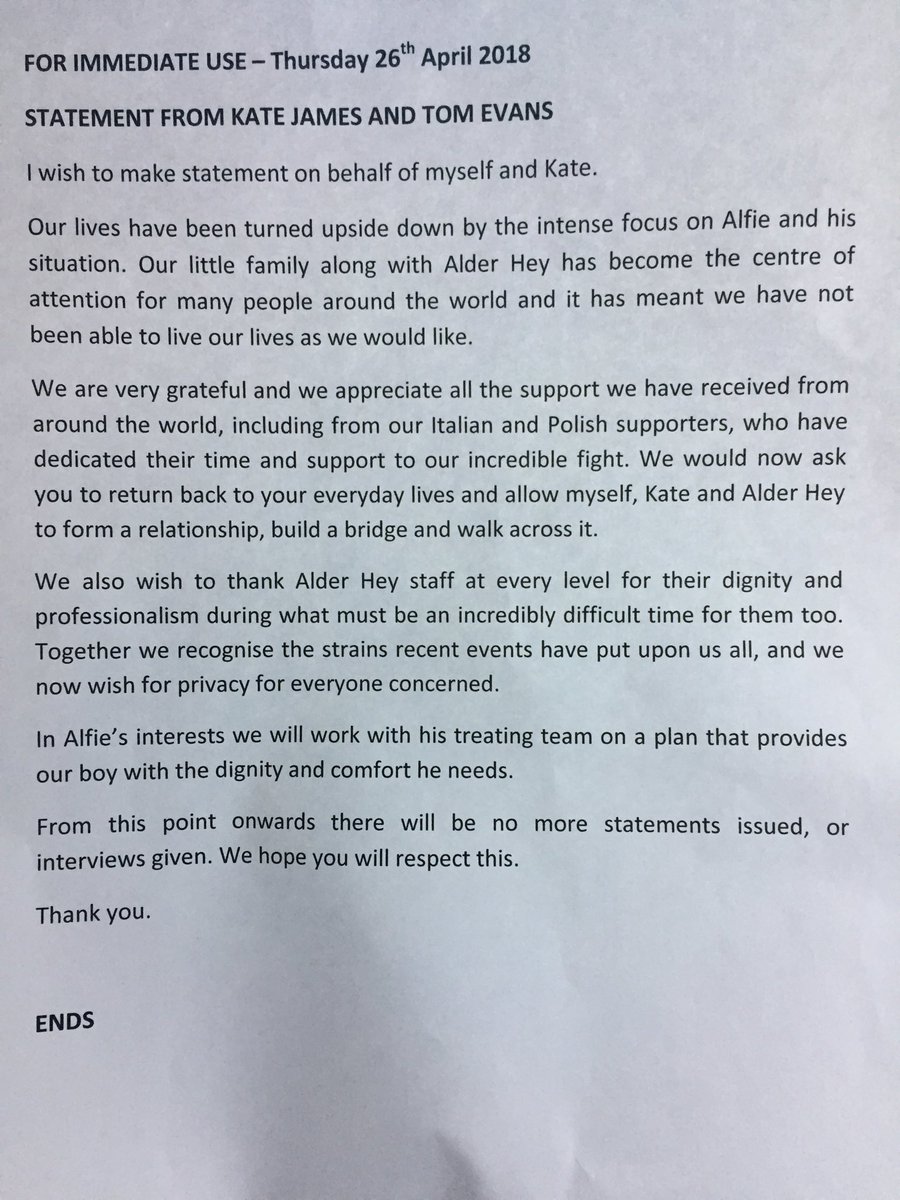
A lot of people also fail to realize that Alfie's father agrees with this assessment:
"“Mr Thomas Evans does not seek treatment. He seeks palliative care in line with his Catholic faith principles,” says his barrister Paul Diamond,"

"Alfie’s receiving food, water, oxygen as well as all the standard drugs for his belly."
Also, many of Alfie's supporters in England do not disagree with this assessment:
Pamela Jacuniak who suggested members of Liverpool’s Polish community rally under Alder Hey Hospital, told Express.co.uk little Alfie has a right to live.
She said: “As Poles, we believe the little boy has a right to live and it is up to the parents to decide where Alfie needs to be treated.
“If we believe there is a chance he can live on then it must be used to 100 percent.
“Each and every one of our hearts are breaking because the judges have ruled in a barely humane way to end Alfie’s life.
“There are patients similar to Alfie in Poland whoa re palliative patients and receive full healthcare until the moment of their death.”
Clearly, at this point, Alfie is receiving the palliative care his father and all the doctors agree is appropriate. Would that have happened without all the publicity? I don't know. Certainly no one expected Alfie to survive without a ventilator. Remember, his parents were originally fighting any attempt to remove it. Since it has been taken away, they have had to resort to mouth-to-mouth a couple of times in order to keep their boy breathing. No one... let me repeat that... NO ONE intimately familiar with his case thinks Alfie can be treated. He can only be made comfortable as he dies. As long as the hospital is supplying hydration, nutrition and oxygen, there is no reason to fly the boy to Italy. Again, it is possible the hospital wouldn't be doing this except for the publicity.  Or it is possible that they would have done. I honestly don't know. But it is not the case that Alfie's situation demonstrates the entrenched evils of socialized medicine, nor is it the case that Alfie's situation demonstrates the parents are evil for wanting palliative care.

Whatever led up to the current situation, it is clearly true that Alfie is currently being cared for as well as can be expected given his horrific medical condition. Food, water and oxygen are ordinary care, not medicine, not extraordinary. The Catholic Church is quite, quite clear on this.

But keep in mind that Catholic teaching denies the necessity to undertake extraordinary care. And, yes, there does come a point in every dying process where those extraordinary measures might actually have turned into torture. The courts have a very legitimate Catholic right to be concerned about that. As the brilliant Dominican theologian Fr. Robert Barry once told me, "You can choose martyrdom for yourself. But you cannot choose martyrdom for someone else." Alfie's parents do not have the right to choose martyrdom for him, and they appear to understand that they do not have that right. Unfortunately, it isn't clear that all of Alfie's supporters understand that.

Now, how do we know Alfie is getting palliative care? The news sources do not agree in all details. Yes, there are contradictory sources out there concerning the exact details of how Alfie is being treated. But I notice the "sources" that say Alfie is not getting palliative care have no direct quotes from the parents, while the sources who say he is getting palliative care are directly quoting the parents, who say that he is.

Whenever you read about cases like this, or news about something the Pope is supposed to have said, or really any case that seems designed to get you angry, remember, there are people who make money off of you when you are angry. There are a lot of news sources interested in stirring up a feeding frenzy so they can gorge on the clicks generated by their click-bait. Don't feed the trolls (I'm looking at YOU, LifesiteNews).

UPDATE:
The charge has been laid that this essay does not deal with the question of parental authority. Alright, let's deal with it. Certainly a parent has authority over his or her own child except when the parent is abusing or neglecting that child, at which point other authorities have a duty to step in. But that's precisely the problem. 
What constitutes "abuse" or "neglect"?

This is where it gets hard. Let's say there is a parent who believes his/her child is possessed, and further believes that severe beatings will relieve the child of the demonic possession. Should "parental authority" permit the parent to "treat" the demonic possession by severely beating the child?

What if the parent hired someone else to beat the child? Is that ok? What if we substitute "illness" for "demonic possession" and the people hired were doctors?  It is a prudential decision to figure out what constitutes appropriate exercise of parental authority. What if the doctors hired to beat the child, examined the child and said, "No, not only are we not going to beat this child, we are going to make sure you don't get anyone else to do it either." Are those doctors violating parental authority?

When Jehovah Witness' parents refuse blood transfusions for their children, should the state force the blood transfusion anyway? What about vaccinations? What about restricting movement during mass outbreaks of illness? Is it reasonable to move a child a thousand miles just so the child can receive exactly the same food, water and oxygen? We all assume that none of the medical professionals are thinking clearly, but what if it is the parents who are not thinking clearly?

This is a serious problem. Munchausen's Syndrome by proxy is a psychological disorder in which a caregiver, usually a parent, seeks attention by acting as if his or her healthy child has a long-term or otherwise debilitating illness. The caregiver's self-image is bound up in being a caregiver, and s/he can't afford for the child to be healthy, because that threatens the caregiver's self-image. But what if the caregiver also can't afford to let an ill child die, because that same psychological disorder also threatens the caregiver's self-image? If the child is dead, the caregiver loses the self-image of caregiver just as surely as if the child were to recover.

What if the parents are suffering from a form of Munchausen's Syndrome by proxy, and dying Alfie is the focus of their pathology? Isn't that a possibility as well? And what happens to parental authority if that is the case?

These are hard questions. A lot of prudence and care have to be taken to make sure the child is not being victimized by anyone - not the doctors, not the parents, not the media, nor any of the people speaking out about the case. I don't know any more details than what I read in the news. Neither do you. Doctors who have personally examined Alfie have all reached the same conclusion: he's dying.

Clearly, there was an argument about palliative care. It is quite possible the hospital has only provided food, water and an oxygen tube because of public pressure. But we are simply ignoring the facts if we think (a) anyone knows how to treat Alfie or (b) he is not being given food, water and oxygen.

The fact is, no one who has personally examined Alfie is offering anything but palliative care. His own father is quoted as saying he expects only palliative care. He is getting palliative care. So, it looks like parental authority is being honored. Perhaps it is only being honored after public outcry, but it is being honored.

Some argue that the UK should just hand the child over to Italy and be done with it. Since Alfie is a British citizen, the British courts have an interest in overseeing care. They can relinquish that interest to Italy, but apparently they don't want to. Similarly, Alfie's parents could just relinquish their interests to the state, but Alfie's parents don't want to. I don't blame Alfie's parents for not wanting to do that, so I can't very well blame the UK courts for displaying the same sentiment.

Update II
Find the court case testimony on Alfie here

And Alfie's parents admit the charges that the hospital staff were evil was mostly a hoax.


Sunday, April 22, 2018

Why We Need Illegals

One in 4 children living in the U.S. in 2016 had at least one parent who was born outside the U.S., according to a study released Wednesday (4/18/2018).
If 25% of the children born in the US are born to immigrants, then are we correct to assume immigrants make up 25% of the US population? Well, no, we aren't:
More than 43.7 million immigrants resided in the United States in 2016, accounting for 13.5 percent of the total U.S. population of 323.1 million, according to American Community Survey (ACS) data.
Immigrants have 25% of the babies, but make up only 13.5% of the population. But what percentage of the immigrant population is illegal?
Lawful immigrants account for three-quarters of the foreign-born population in the U.S. – 33.8 million people out of 44.7 million in 2015, the most recent year for which numbers were available.
So, illegal immigrants are 25% of the immigrant population. But wait! How many children are there in the US?
[T]he number of children (under age 18) in the United States is at an all-time high of 74.2 million. But, the share of the national population who are children is at an all time low of 24%. Based on data from the 2010 census, we find that while there is a small increase in the number of children, the rate at which that population is growing has slowed dramatically over the past 20 years.
Wow. The population of children is not growing much. But, if the US has 74 million children, and one in four belong to immigrants, then 18.5 million children belong to immigrants. What percentage of those 18.5 million belong to illegal immigrants?
4.5 million children born in the U.S. lived with at least one undocumented parent.
If illegals have 4.5 million children, and immigrants have 18.5 million children, then illegals have 25% of immigrant children.

Conclusion:
Immigrants make up 13.5% of the nation.
Immigrants beget 25% of the nation's children.

Illegals make up 25% of the immigrant population.
Illegals beget 25% of all immigrant children.

Immigrants, both legal and illegal, are punching way above their weight when it comes to producing the next generation of Americans. In fact, immigrants produce twice as many children as we would expect (Notice that the all-time high percentage of immigrants to this country is 14.8% in 1890. We aren't at peak immigrant.)

Why are immigrants producing so many children? Because the median age of America is 37 and rising. As a nation, we are slowly approaching menopause. The median age of white Americans is 43, with a modal age of 55. That group is well past menopause.

On the other hand, legal immigrants are, on average, much younger than Americans. Illegal immigrants are, on average, much younger than legal immigrants.
Lawful immigrants are more likely to be of working age (18 to 64) than people born in the U.S. ... Three-quarters (76% in 2014) are in this age group, compared with 60% of the U.S. born and 92% of unauthorized immigrants.
But, even though immigrants are much younger than the rest of Americans, and even though immigrants have twice as many kids as the rest of America,  America's fertility rate is still below replacement level. It is just 1.8 children per fertile woman. It needs to be 2.1. We are turning into Japan, a nation that currently sells more adult diapers than baby diapers.

Mars needs women. So does America. Fertile women. Legal, illegal, doesn't matter. If we don't have children, we disappear as a nation. Ask Toys R' Us or America's colleges and universities how America's contraception/abortion mentality that kills off children (i.e., future customer/citizens) works out.

We need illegals as much as they need us.

Saturday, April 07, 2018

A Modest Proposal

According to the World Bank:
Cities are major contributors to greenhouse gas emissions. Half of the  world’s population lives in cities, a share that is likely to reach 70 percent in 2050 (Figure 5). Cities consume as much as 80 percent of energy production worldwide and account for a roughly equal share of global greenhouse gas emissions.
 According to Pew Research:
In 2008 Barack Obama won 88 of the 100 most populous counties; in his re-election bid four years later he won 86. ... A 2014 Pew Research Center report on political polarization found that liberals are about twice as likely as conservatives to live in urban areas, while conservatives are more concentrated in rural areas.
So, Democrats cause global warming. Which means America can easily solve its global warming problem: just kill all the Democrats. Problem solved. And our overpopulation problem goes away at the same time. Government efficiency at its finest.

Saturday, March 31, 2018

Why Is Easter Vigil Mass on Saturday?

Jews count days as beginning at sundown because that's what Genesis says, "Evening came and morning followed, the first day" (Genesis 1). Catholicism is the completion and perfection of Judaism, so for purposes of liturgy, Catholics calculate days the same way.

That's why you can go to Mass on Saturday evening, but it counts for Sunday - the Saturday evening Mass is technically supposed to be after sundown, so that Sunday has already begun, liturgically and Scripturally speaking. Now, this poses a problem for modern man. After all, sundown varies from season to season, but people have a hard time scheduling an event whose start time might vary literally day to day. What to do? The Church allows the local bishop  to unilaterally decree a set time for "liturgical sundown" that holds throughout the year for when Sunday liturgy may begin. So, Saturday evening Mass can only start after 4:30 PM or 5:00 PM, or whatever time the bishop has set. Anything prior to that only counts for Saturday, not Sunday. Anything prior to that uses Saturday's Mass readings, not Sunday's.

And this is precisely how we calculate that Jesus' body spent three days in the tomb:
  • 1st day: Jesus died on Friday before sundown, so He is dead on Friday. Nicodemus has to get His corpse into the tomb before sundown in order to honor the Sabbath rest. We assume that he, being a good Jew, managed this. Mosaic law decreed that anyone hung on a tree should not hang overnight, but should be buried before sundown (Deut 21:23).
  • 2nd day: Friday sundown to Saturday sundown.
  • 3rd day: Once the sun is down on Saturday evening, the third day has already begun. Jesus rises some time after Saturday sundown, possibly around midnight or 3 AM, so He rises on the 3rd day.
This is why none of the Jewish contemporaries to the apostles contested the fact that Jesus was in the tomb for three days. By everyone's count, He had been.

This also explains Easter Vigil Mass. Easter Vigil Mass is any Mass that begins after Holy Saturday sundown. As long as it begins after Saturday sundown, it begins on the third day. In fact, the rubrics indicate that the Easter Vigil Mass is not to begin until the first star can be seen in the sky.

Incidentally, there are actually three different Easter Masses: the Easter Vigil Mass, the Mass at sunrise and the Mass for the day. Each Mass has different readings and a different significance in the life of the Church. But it is the Easter Vigil Mass that all Catholics are encouraged to attend.

Only the Easter Vigil Mass has not one, but two different plenary indulgences attached: the renewal of baptismal vows at Vigil Mass is a plenary AND the fact that you attended a Mass wherein someone received First Communion is also a plenary. Now, you can only win one plenary indulgence a day, but the fact that there are two in operation here is kind of neat. The Easter Vigil is considered the Mother of All Feasts - it is the Mass from which all other Masses draw power and grace. It is the conduit of grace into the full liturgical year.

It's also a lot of fun to watch the candidates get baptized, if only because baptismal water is supposed to be running (thus "living" water) and cold ("we are baptized into His death"). The ancient instructions preferred a river to a lake (living water over still water) and cold water to hot. I have been to baptisms where the candidate accused us of having put ice into the water. To which, I don't see the problem, because we took the ice out before the Mass started, so...

Scalfari and Pope Francis

There has recently been much brouhaha about the Italian journalist Scalfari's mis-reporting of Pope Francis' words. Scalfari is 93, an atheist, and has a history of mis-reporting facts when it comes to the Pope.

The Pope continues to allow him personal access, continues to speak with him. Now Scalfari reports that the Pope says there is no hell. Many Catholics, disgruntled with the Pope, have insisted that Scalfari must be reporting correctly, that this is merely one more instance of the Pope's heretical leanings.


Normal, sane Catholics smile and shake their heads. We recall all the times the Pope has taught on hell, and the need to avoid it, and we laugh at the poor memory, the foot-stamping anger, of some of the Church's smaller children.

So, why does  the Pope keep speaking to an atheist who is so near death? To sane Catholics, the answer is obvious. In Les Miserables, when the bishop hands the silver to the thief, the old maidservant can't understand why the bishop is doing this. But we in the audience applaud the bishop for doing the Catholic thing. With every meeting, the Pope hands the silver to a dying atheist journalist, a thief who steals the truth with his words instead of his fists.

So, we can be the sane Catholics who applaud the Pope.
Or we can be the old maidservant, who can't understand what the bishop is doing.


Choose


Thursday, March 29, 2018

Confession on Good Friday and Holy Saturday

The Congregation for Divine Worship issued the document Paschales Solemnitatis in 1988 which states:
"59. On this day [Good Friday], in accordance with ancient tradition, the Church does not celebrate the Eucharist: Holy Communion is distributed to the faithful during the Celebration of the Lord's Passion alone, though it may be brought at any time of the day to the sick who cannot take part in the celebration." 
"61. All celebration of the sacraments on this day is strictly prohibited, except for the sacraments of Penance and Anointing of the Sick. Funerals are to be celebrated without singing, music, or the tolling of bells." 
"74. On this day [Holy Saturday] the Church abstains strictly from the celebration of the sacrifice of the Mass. Holy Communion may only be given the form of Viaticum. The celebration of marriages is forbidden, as also the celebration of other sacraments, except those of Penance and the Anointing of the Sick."
If your priest thinks he is forbidden to hear confessions during Triduum, he is sadly misinformed.

Wednesday, March 21, 2018

A Skillful Liar

My son sent me an interesting piece from Chronicle of Higher Education about what a modern scholar thinks the university should be. 
The author of that Chronicle piece is a liar.

First, he fails the very first test of a true humanities scholar: he refuses to define his terms. When faced with the problem of defining what constitutes humanities, his response is, "We know it when we see it." That is a lie.

Take Shakespeare, for instance. He is the cornerstone of English literature, yet it is possible to get advanced degrees in many places without ever taking a course on Shakespeare.
Conservatives want the humanities, but they define the humanities as including the Great Books, among which Shakespeare is extremely prominent. Liberals (who control the actual delivery of humanities course content at universities), refuse to build their "humanities" program around the literature of dead white European males. They instead think the cornerstone of the humanities is identity politics, and they build their courses accordingly.

So, the author wants to pretend there is some kind of paradox between conservatives espousing the humanities and those same conservatives refusing to fund it. However, once you realize the problem that the author refuses to engage, to wit, there is a huge disagreement about what the humanities really are, then you realize there is no paradox at all. Conservatives don't view university liberal humanities courses as actually having anything to do with the humanities, therefore they refuse to fund the farce.

The author's matching paradox, the idea that liberals defend the humanities, but have gutted it of Western European values, is also not a paradox once you realize how the left defines "humanities." From their point of view, they are cleansing the humanities of bias and taint, not gutting them
And liberals have successfully redefined the humanities into their own image simply because they do control the course content. Of course, by redefining the humanities, they've destroyed any reason there might have been for taking any courses. After all, if humanities is merely identity politics, I don't need to pay $40,000 a year to have a university professor tell me who I am. I can simply look in the mirror. My own life experience is worth much more than any dead white European male's introspections. I don't need to go to university to know what my own life experience is. So, the liberal definition is self-destructive. If the liberals are correct, if the humanities really are nothing but identity politics, then the humanities courses have no reason to exist.

But the author can ignore this entire problem and construct fake paradoxes if he doesn't engage the definition. And he KNOWS this, so he deliberately doesn't engage the definition.

Second, this allows him to make absolutely absurd remarks like this, "A school — be it a Gymnasium, a Realschule, a lycée, a grammar school, or a public school — exists to teach. The university is a different kind of thing. It was founded as a corporation or union of masters, both to allay the pernicious effects of competition for students and to exercise some sort of quality control on the doctrine propounded. "

This is simply incorrect. In the original university setting, the students hired the professor directly. Students pooled their money to bring someone in to teach them. If the professor turned out to be a bust, the students fired him and hired someone else. The "union of masters" came into existence to prevent this. Everyone in the union agreed to work only for a contract that the students couldn't break. This mean professors didn't have to worry about being fired because they stunk.That's where the tradition of "tenure" arose. The "pernicious effects" and "quality control" nonsense ("We're here to help YOU!") was all introduced as an excuse to the rubes, that reasoning was used to hide the fact  the professors had gotten together to protect their rice bowls, their income.

He kind of even admits that this was the situation when he says, " Indeed, some universities, like Cambridge, supported a vast ecosystem of teachers who played a vital role in the actual education of students (for pay), but who had no formal connection to the university itself." Yeah, no kidding.
Third. But this yahoo doesn't stop there. He then simply makes up nonsense out of whole cloth about the university curriculum. Part of "travers[ing] the arts curriculum" was always education in Catholic theology. Is the author advocating that? If not, why not? He wants the arts, he should have ALL the arts, right?
Again, he half-way admits this when he says, "Alongside the arts were the three highers — theology, law, and medicine." But he couldn't bear to admit this without deliberately lying again. After all, since theology, law and medicine are HIGHER arts, then the other seven (the trivium and quadrivium) sat BELOW the three major arts and drew their authority from them. 
And, actually, medicine was an also-ran. The original reason for the universities were theology (making God's ways known to man) and law (making man's ways in accordance with God's ways). Medicine was added later. Theology and law were NOT "alongside." Theology and law were central.  The trivium and quadrivium were not alongside, they were BELOW and DERIVATIVE.

This allows him to tell the biggest lie, "The reality is that the humanities have always been about courtoisie, a constellation of interests, tastes, and prejudices that marks one as a member of a particular class." Which is a careful half-truth. The humanities have always been about being CATHOLIC, being universal, having a universal palate, able to absorb all the things of men, weigh all the things of men, because all of mankind is called to Christ.

Compare the universal call to holiness to the modern "humanities" of identity politics. The modern humanities is not about binding everything back together again to make one harmonious whole, it is not about universality or university, it is instead about identity politics and fragmentation.
Again, the author pretty much admits this when he explicitly SAYS that the humanities are about fragmentation, not universality, "Deep down, what most humanists value about the humanities is that they offer participation in a community in which they can share similar tastes in reading, art, food, travel, music, media, and yes, politics" The emphasis here is on the "similar tastes." All the blacks sit at this table, all the Mexicans at that one, the whites can go sit by the kitchen, and keep the Asians near the door, because they should really just leave. The modern humanities don't want similar tastes, but similar distastes - hate the white guy, hate the Asian, hate the "privileged", hate the hetero.
The author is a liar, but a skillful one.


I can only wonder if he is a true believer in his own lies.

Thursday, March 15, 2018

The 10-Second Fast

The Ten-Second Fast

A lot of people want to test themselves during Lent by learning how to fast. That is a laudable endeavor. But not everyone can fast.

Diabetics, children, the aged, pregnant women... there is a long list of people who, for various medical reasons, simply cannot fast. Or, you might not have a medical reason, but you might still be unable to fast. For instance, you might find yourself in a social situation where it would insult the host if you did not consume food. Catholic Faith is not meant to insult people. As long as you break no Church law, then breaking your fast with your host is the charitable thing to do. The person you interact with is an image of Christ, the Bridegroom. You don't want to let your personal fast turn you into the man at the wedding feast who refuses to eat.

So, does this mean that if you have a medical condition or are in an awkward social situation, you cannot fast?

No, not at all.

Remember, apart from the prescribed fasting times, such as Ash Wednesday, Good Friday or the Eucharistic Fast, there is no "minimum length" to a fast. There are people who have tried to fast for 40 days (the Church recommends against this, by the way). Bully for them. But that is really not necessary. The Eucharistic fast used to be a lot longer than the single hour we now observe. But the fact that it is shorter is not really the problem people make it out to be.

As St. Thérèse of Lisieux observed:
I will seek out a means of getting to Heaven by a little way—very short and very straight, a little way that is wholly new. We live in an age of inventions; nowadays the rich need not trouble to climb the stairs, they have lifts instead. Well, I mean to try and find a lift by which I may be raised unto God, for I am too tiny to climb the steep stairway of perfection. [...] Thine Arms, then, O Jesus, are the lift which must raise me up even unto Heaven. To get there I need not grow; on the contrary, I must remain little, I must become still less.
In honor or her brilliant, insightful way of presenting the ancient teaching, we recognize the truth: it isn't the length or difficulty of the task that makes it holy, it is the love which with the task is done. The rich man may give away his wealth, but if the beggar woman throws her penny into the collection with great love, than her contribution is greater than that of the rich man who loves less.

And so we find the meat of the matter. If the length of the fast isn't really relevant (and, apart from the Church's prescribed fasts, it isn't), then a Catholic's voluntary fast can be of any length. Even ten seconds is enough. And anyone can do a 10-second fast.

Have you just become aware that you are thirsty?
Then, while you contemplate God with love, simply refrain from drinking anything for a count of ten.

There.
You have fasted.
Now take your drink of water, satisfy your health needs, make your host smile, and no one is the wiser but you.

Done with great love, this ten-second fast is a greater accomplishment than a 40-day fast. You can fast for the whole of Lent, in ten-second, five-second, one-second increments, here and there, scattered throughout your day. Diabetic, pregnant, child - it matters not. You still consume all you need for health of the body, while fasting as you need for the health of the soul.

And so the day becomes holy, and God is woven into your life, and Lent fulfills its purpose.


Wednesday, March 14, 2018

Laissez-Faire Capitalism is a Unicorn

Everyone goes on about how chimerical socialism is. The defenders of socialism always insist that it has never actually been implemented anywhere. The opponents of socialism point out that every attempt to implement it results in economic collapse and a slew of body bags. Opponents are therefore correct to point out that socialism is a complete failure.

But laissez-faire capitalism is no better. Supporters insist that small government is really best, as small government encourages the free reign of capitalism. But every time capitalism is tried, we get big government, not small government. The only time anyone ever got small government was right after a revolution turned over the apple cart. As soon as the revolution is over, government grows, because it can't do anything else. 


Just as socialism always leads to big government and body bags, so laissez-faire capitalism always leads to big government and bureaucracy. It cannot do anything else. The very definition of how to be a good capitalist involves maximizing all streams of revenue. Government is, and always will be, one of those revenue streams, so it is always in the interest of capitalists to grow the government, just as he would grow any other aspect of his business.

Big government allows successful capitalists to suppress the competition, via government's law-making ability, and to increase revenue, via government's taxing ability. Any good capitalist is going to take advantage of those attributes. If he doesn't, he isn't a good capitalist.

This is why there is always a revolving door between business and government. Business needs ex-government leaders in-house, so they have experts available in how to co-opt government. Government needs ex-business leaders in-house so it knows how best to facilitate income generation and tax revenue streams. A good businessman always tried to capture government, and government will always allow itself to be captured, because it is run by businessmen who came in through the revolving door.

Laissez-faire capitalism ineluctably grows the government. Precisely because capitalism leads to the best businessmen getting the best outcomes for their businesses, it cannot do anything else.


Wednesday, February 21, 2018

How to Teach Math

Several years ago, I wrote a column explaining why math is an important subject. In it, I pointed out that the actual content, that is, the actual mathematical manipulations, didn't really matter.  What matters in math is the meta-concepts.

To be successful in math, you have to master an approach to the world that is inherently useful. College majors typically require mastery of a math course not because anyone cares about math, but because passing a math course is the easiest way to demonstrate mastery of the meta-concepts that everyone actually does care about.

Once you realize that math is about meta-concepts, and not about math at all, teaching math becomes really very easy.

1) Buy a math notebook.

Every frustrated math student, everyone who is poor at math, has one thing in common: they don't organize their work. They scribble numbers down all over the page without regard to sequence. If students learn ANYTHING in math, they must learn to break that habit.

So, beginning students should be actively discouraged from doing math in their heads. Yes, I know the Math-Bowl encourages this for the advanced students who compete, but it's not a good idea for beginners. Beginners need the external structure. So, buy a THICK, empty math notebook, with lots of empty pages.

2) Throw out the calculator

For basic math, they don't need it.

Calculators interrupt the student's concentration, forcing him to alternate between doing the procedure the problem requires and doing the procedure the machine requires, figuring out the correct sequence of key punches.

Calculators are mostly a distraction. No one needs a calculator until they start doing trigonometry or statistics. If they aren't doing either, then let them learn the multiplication tables.

If you think calculators should be allowed on basic math tests, then why shouldn't cell phones and internet access be allowed for reference on history or English tests? The Internet is the equivalent of a history or grammar calculator. Why bog down the student with memorization of useless dates and grammar rules when they could be doing higher-order stuff?

Now, watch the history and English teachers howl in outrage that you should suggest such a thing. Watch the math teachers smile sadly and say, "Yeah, well, welcome to our world, suckers."

3) Write down each step

The student must write down each problem as follows:
  1. On the first line, the problem itself
  2. On the second and subsequent lines, write each successive step.
  3. No more than one operation (add, subtract, multiply, divide) is permitted in any step.
  4. The answer is written at the bottom of the step sequence. 
No scribbling in side margins allowed at all. Don't allow multiple operations in any one step because beginning students get themselves confused easily. Each step does exactly one thing, that is all.

Ignore their whining. Even if a beginning student gets the answer correct, the problem is wrong if they haven't shown all their steps. Make that clear. Stand over them for a month, enforce it, and they will gain the habit. Ingraining into them this single, solitary little trick solves over half your math problems overnight.

4) A fresh sheet of paper for every problem 

Math is not an exercise in conserving paper. Be profligate. Paper costs less than half a cent a sheet. Splurge. Once they have successfully trained themselves to write out every step, you can alter this rule to allow more than one problem per page, but even then NEVER let them break a problem over two sheets of paper. Ever. No. I mean it, don't do it.

Beginning students get a feeling of accomplishment from seeing all their work laid out neatly at a glance. It feels restful, as the eye glides downhill through the gears of the problem and finally takes up its ease at the bottom of the sequence, peacefully resting upon the (correct) answer.

5) When they get stuck

First, if there is ANY sign of margin scribbling, turn the old sheet of paper face-down, start on a fresh sheet.
No.
Do it.
If you start on the old sheet, all the old scribblings will be a distraction. The student will wander down rabbit-trails trying to figure out what went wrong with the previous procedure. Clear his mind. Start fresh. Give him the gift of new eyes and a clean slate.

Now, math teaches a lot of (seemingly) arbitrary procedures. The student has to know all the procedures and know when to apply which procedure. Both parts of this are hard, but the second part - knowing when to apply which procedure - is the hardest. So, when he gets stuck and isn't sure what to do next, here's what you do:
  • Ask him a question you are sure he can answer.
  • When he answers correctly, affirm it ("That's right."), 
  • Rinse and repeat. Ask a series of questions, each one of which you are confident he can answer.
  • Build that series of questions so as to lead him to or through the correct procedure.
  • In basic math, this question will always come up at some point: "Do you think you would add, subtract, multiply or divide?" Those are the four basic operations, and one of them is almost certainly going to be part of the path to solving the problem. 
  • The student is almost always able to weed out at least a couple of the operations. That instills self-confidence, it shows partial mastery.
  • Don't give the student the answer. 
  • Ever. 
  • Always respond with a question you know s/he can answer.
  • Once s/he has gotten the answer, point out the truth: "I didn't tell you the answer. All I did was ask questions. You KNEW all the answers. You already KNEW how to do it."
  • And the student DID know how to do it. He just needs to internalize how to ask himself the same series of questions you asked.
  • Don't point this out. 
  • Simply keep repeating this sequence with him on every problem he has, week in, week out, making sure he writes down every problem step-by-step
  • He will learn to internalize the question sequence himself. He will start asking and answering his own questions. 
  • At that point, you can go bake brownies.
  • This whole sequence only takes a couple of months to instill. 
Once this basic skill set is instilled, it is now permissible to have the student walk through the steps of a failed problem to see where the mistake was made.
  • If each step has only one operation, it will be relatively easy to see which step failed. 
  • Now the student will see the wisdom of the step-by-step process.
  • He doesn't have to re-do every problem from scratch. 
  • He can find and correct his own mistakes easily.
  • Once he realizes this, math becomes almost bearable.

6) When YOU get stuck

Don't be afraid to say, "I don't know. Let's Google it." You don't have to know everything in math. In fact, you don't have to know ANYTHING about math. Remember, math isn't about math. Math is about learning how to be
  • organized, 
  • good at documenting details, 
  • good at being detail-oriented, and 
  • good at following and trusting arbitrary procedures.
None of those skills require you to know the arbitrary procedures yourself. Even if you are no good at math, you will naturally be better at searching for the correct way to do it. Model how to search for the right way to do things. Have your student watch you as you bumble along, figuring it out.

The student thereby learns:
(1) it is ok to not know something,
(2) this is how you find out what you don't know,
(3) Searching for the right procedure takes time and that's also ok,
(3) Perseverance can be as important, or more important, than possessing knowledge.

That's all there is to teaching math.
Seriously.

Well, that and liberal use of Khan Academy. Yes, I have a degree in computer science, minor in math, and have taught developmental math at the college level for years, but I taught my children almost no math at all. There's no point. Khan Academy teaches the concepts as well or better than I could. I only got involved if a video was opaque (unusual) or a solution sequence unclear (also unusual).

Often-times, I would walk along through the Khan Academy solution to the problem as perplexed about the correct sequence as my child was. It's not like I remember most of the stuff I learned thirty or forty years ago. We would discover the solution together, which was rather fun.

As for which math subject they should tackle first, it literally doesn't matter. Addition and subtraction of whole numbers is fine as a start, but they can choose where they want to go next. There are different badges associated with mastering various pieces - every time they earn a Sun Badge, buy everyone ice cream to celebrate. Those are hard to get, and it gives them something to work towards.

Treat every problem as a jigsaw puzzle. No pressure because, let's face it, there is no pressure. They're eight or ten or twelve. If they don't learn something this year, they'll learn it next year. Who really cares? Michael Faraday, Thomas Edison and E.O. Wilson were all famously bad at math. Wilson didn't take algebra until his freshman year of college, and didn't learn calculus until after he was a tenured professor. Things happen. Just give it your best shot, and have fun with the puzzles. 

No, the only way I have ever taught math was to follow the sequence I have described above. It works.

Update:

A friend reminds me that I have omitted an important step.  Obviously, patience on the part of both teacher and student is a developed skill that is the absolute key to the method, on both parts.

But here's the step I'm missing: constantly remind the student that math requires only one thing - it simply requires you to be as perfect as God. You can't make any mistakes. Easy, eh?

I used to regale the children with stories of mathematicians who made very simple mistakes and destroyed millions of dollars worth of equipment, or entirely killed people. Everyone makes math mistakes, even the most skilled engineers and mathematicians. As I have frequently pointed out, I am a math teacher because I have gotten thousands more problems wrong than any of my students. My students can only become math teachers if they have failed as often as I have.

Fail early and often!
Join our club!

Is Wealth Inequality Bad?

Many people, including Pope Francis, rail against wealth inequality. From an economic perspective, it is not at all clear why. Wealth inequality actually corresponds quite well with the rising tide of affluence throughout the world. Right now, during a period of the most extreme wealth inequality between nations ever, we are also on the verge of wiping out extreme poverty. This is not a coincidence.

I have noted before that the office of the papacy does not include the requirement that the Pope be very knowledgeable of economic theory, nor that he be very intelligent in his comments on it. While the Church has a duty to serve the poor, the method by which the poor are best served is largely prudential - different people might legitimately choose different means to solve it. Wealth inequality, by itself, is not a sin so long as everyone's minimum requirements for food, clothing, shelter, education, medical care and basic human dignity are being met. Quite frankly, all but the last of those minimum needs are being met much better today, in a time of enormous wealth inequality, then they have ever been met in the entire course of human history.

In fact, things have gotten so much physically better precisely as a result of growing wealth inequality. Wealth inequality is correlated with EVERYONE getting out of poverty.
The "trickle-down" theory of Reaganomics is a fine example of how inequalities actually help everyone. Even Ted Kennedy admitted that much. The rising tide which brings incredible wealth to the 1% ALSO lifts the 99% out of poverty. The mechanics for how it works is very straightforward.

Take laparoscopic surgery, for instance. When I was young, that was only an option for millionaires. But, as more millionaires bought the procedure, economies of scale kicked in and semi-millionaires could afford it. There were a lot more semi-millionaires than there were millionaires, so scale kicked in again, repeatedly. As cost fell, more and more people could afford it, so more and more people did it, which dropped costs still further. The increase in scale also meant the procedure became increasingly streamlined and efficient, if only so as to handle the demand better.

Today, laparoscopic surgery is standard procedure for gallbladder and appendix removal, among a host of other applications. It provides cheap out-patient surgery that simply didn't exist 50 years ago. Why? Because millionaires volunteered to act as the guinea pigs. They were the only ones who could originally afford it. As they and their extremely well-paid doctors refined the procedure, it became increasingly available to the rest of us. Today, it is so common that it doesn't merit mention.

The same thing happened with cell phones. The original radio phones and cell phones were the size of bread boxes and cost more than any average Joe could possibly afford. But millionaires needed to stay in constant contact with their businesses and with the stock market, so they bought the tech. They served as the guinea pigs. As scale increased, price dropped, efficiencies improved. Now, literally everyone in the US can afford cell phones. And not just cell phones. Today's phones are the 1960s equivalents of super-computers that fit in our pocket and put us in touch with most of humanity's combined store of knowledge. The rich people and their richly rewarded tech outfits worked out the kinks. We have all benefited.

THAT is what wealth inequality does. It allows millionaires to act as guinea pigs for new tech. If it doesn't work, they waste their money and/or die. If it DOES work, then I get the tech about fifteen years later, because by then, the cost has dropped down to where even I can afford it.

Wealth inequality is an extremely efficient way to utilize resources. If I have a new tech idea, I can either try to convince tens of thousands of middle-class people to fund my idea, at great personal risk to each of their wealth stores, OR I can convince one extremely wealthy person to fund it at minimal risk to his wealth store. It was easier to do the latter than the former. Even today, being on Shark Tank will bring you funding in literally 20 minutes, while promoting the same project on Kickstarter will take days, weeks, or months to accomplish the same level of funding. It is far easier for Elon Musk to guide a project like the Falcon Heavy or BFR to successful completion than it is for ten thousand people to agree on how to do so, and that assumes you could get the funding from that ten thousand at all.

Wealth inequality is not the problem many people make it out to be. In fact, wealth inequality has historically been the solution which has made us all fabulously wealthy by any historical standard you care to name. Because of wealth inequality, the rich are willing to serve as the experimental guinea pigs necessary to bring functioning solutions to the masses. That's not a bad thing.

We have a knee-jerk reaction against wealth accumulation because we innately see the world as a zero-sum game. And the fallen world often acts and reacts as if it were. But the whole point of Christianity is to change our world-view. A Christian understands that God's grace and power are infinite, therefore the zero-sum game view can never be correct. Insofar as we image God, we have the ability to change our world from being zero-sum to being infinitely resourceful and wealthy.

Can we create Utopia? Physically, sure. Spiritually, not a chance. We are still fallen creatures, and that will always prevent us from establishing any real paradise on earth. We are slowly solving the problem of physical poverty. It really is going to disappear, possibly in our lifetimes.

But spiritual poverty? As long as anyone in the world is not Catholic, then the world still suffers from extreme spiritual poverty. THAT is the wealth inequality which we, as Catholics, need to remedy. Fortunately, from that viewpoint, Catholics are the rich one-percent. We have infinite resources that can be delivered to the poor among us, and make them all wealthy too. As physical riches percolate out into the world, that is the only wealth inequality we really need to be concerned about.